Natural Capital Performance Differentiation: A Review of the Evidence for Asset Allocators
Executive summary
Natural capital investing continues to evolve as institutional allocations grow and disclosure frameworks like the European Union’s Sustainable Finance Directive Regulation and the Taskforce on Nature-related Finance Disclosures require action on nature related opportunities and risks. Current allocations don’t yet fully align with stated intent on natural capital, nor with the available set of institutional-grade land-based climate and nature strategies. Moreover, asset managers evaluating nature-related investment opportunities lack robust cross-asset comparative analysis of “uplift potential” for those pursuing particular environmental outcomes.
This paper examines the evidence on performance of sustainable forest management, organic/regenerative cropland agriculture, and actively managed grazing, using evidence from meta-analyses and broad-scale studies. It aims to offer a high-level cross-asset comparison of relative strengths and weaknesses across core metrics required in nature-related disclosures (land use & productivity; water; soil health; climate; biodiversity). Across forests, cropland, and grazing lands, sustainable management approaches show measurable ecological differentiation relative to conventional management baselines, but uplift potential is quite variable by metric category and evidence is in some cases much less robust than might be expected. Each domain has a unique profile in terms of ecosystem services such as carbon accrual and storage, water quality and infiltration, productive stability and resilience to disturbance, and wildlife habitat provision.
Different management approaches show distinct strengths in delivering uplift relative to their conventional baselines. Sustainable forest management has shown evidence for biodiversity protection and sustainable yields with reduced harvest damage compared to conventional forestry. Regenerative cropland and actively managed grazing excel at soil health improvements relative to conventional practices, with grazing systems also showing strong potential for water quality improvements over “business as usual” even as productivity-per-hectare increases. However, trade-offs exist: organic cropland faces productivity gaps compared to conventional systems, while the net long-term climate benefits of managed grazing relative to continuous grazing are more contested than those of sustainable forestry approaches due to methane emissions potentially neutralizing increased soil carbon accrual.
In considering implications for global targets for nature, studies suggest that sustainable forestry investments may play an important role in maintaining high-value ecosystems. Actively managed grasslands, though conspicuously absent from current reported allocations, show potential in terms of restoring degraded land, followed by sustainable forestry. Both, as well as organic and regeneratively managed cropland, align well with sustainable production priorities.
Rather than seeking a single “best” natural capital strategy, asset managers may benefit from a portfolio approach: allocating across these complementary systems may allow investors to diversify ecological outcomes, align different assets with specific conservation and restoration goals, and potentially manage risks associated with climate uncertainty, policy evolution, and market volatility within any single biome type.
Natural capital as an emerging investment theme
Investments in farmland and forestry have been part of some institutional and high net worth investors’ portfolios for decades. These strategies have historically been included in portfolios due to their diversification characteristics, inflation-hedging potential, and relatively low correlation with traditional assets. Over the last five years, natural capital as an investment theme has gotten increasing institutional attention. Beyond traditional portfolio considerations, several emerging regulatory, environmental, and market drivers have increased interest in land-based natural capital themes.
The first driver relates to resilience: a natural capital lens promises to help investors identify risks and opportunities associated with structural forces like climate change, land and water scarcity, increased pressures on food production, and policy changes.
Policy and disclosure frameworks related to climate and nature are a second driver. Europe’s Sustainable Finance Disclosure Regulation (SFDR) came into full effect in 2023. It requires financial market participants to disclose how sustainability risks are integrated into investment decision-making and the potentially negative impacts of existing investments. Globally, the Taskforce on Nature-related Financial Disclosures, a framework for reporting on nature-related dependencies, impacts, risks, and opportunities, currently counts some $20 trillion in assets under management by its 730 signatories. TNFD came into full effect in 2025, when all signatories were expected to publish their first disclosures. Currently participation is voluntary, but some elements of TNFD guidance have already been incorporated into the EU’s Corporate Sustainability Reporting Directive, and the TNFD framework is expected to be incorporated into other domestic regulatory frameworks in the coming years, including in the UK. Many institutional investors have observed the regulatory trajectory and concluded that there may be an opportunity to deploy money into natural capital. 1
Current natural capital allocations by TNFD and SFDR-aligned asset owners
Although nature-based solutions including carbon credits, outcomes-based payments, and nature-linked debt are receiving increasing attention, familiar land-based strategies may offer a place to start as far as increasing allocation to a natural capital theme. Among institutional asset owners who are TNFD signatories or subject to the SFDR (or SFDR-aligned regulations), current land-based allocations are still almost entirely concentrated heavily in timberland and farmland. But a new natural capital lens is evident in decision-making and reporting. For timberland investments, certified sustainable forestry is now table stakes for these asset owners. Agricultural investments typically focus on conversion to organic or regenerative production, and a number of investors specifically note location in an OECD country as a criterion, driven at least in part by documented cases of land-grabbing and other human rights violations in an earlier generation of investments in agriculture in countries with weaker governance. 2 Investors describe possible interest in private market investment in biodiversity credits and regenerative production as emerging opportunities, but cite a lack of pipeline development and co-investor partnerships as a significant constraint.3
This is in part because there are, simply put, limited nature-positive direct investment options that are a good fit for institutional investors at present outside of timberland and farmland. Nature-linked debt is growing rapidly but still poses challenges for investors related to standardization around metrics and triggers.4,5 Investments in environmental credits and other ventures delivering verified carbon, biodiversity, or water credits have been the subject of a lot of recent interest and optimistic growth projections. Yet small ticket sizes, long timelines, risk-return profiles, and the scale, newness, and (in some cases) volatility of the underlying market for credits make such ventures a mismatch for many institutional investors.6,7 A recent review of the nature-based solutions pipeline found that more than half of nature investments were valued at less than US$10 million, and only 3% of disclosed investments exceeded $50 million.8
Current allocations reflect an incomplete picture of land-based nature solutions in another sense, too: the biomes in question. Grasslands and rangelands have seen limited institutional investment despite their enormous scale (being roughly equal in global land area to forests and cropland combined9). Yet there is significant potential to support climate and biodiversity goals; restoring degraded grazing lands could sequester 0.13–2.56 GtCO2e/yr (mostly below-ground, and relatively well-protected from drought and fire), a sum comparable to global potential for carbon dioxide removal through improved forest management. 10,11 In terms of biodiversity values, grasslands and savannas are among the most threatened and least protected ecosystems (<10% of grasslands are currently safeguarded from threats at present). For this reason, we include grasslands alongside forests and agricultural croplands in our review. This rationale is reinforced by recent TNFD disclosures, which identify beef and cattle operations as lagging significantly behind other forest-risk commodities (palm oil, timber, soy) in adopting deforestation commitments, creating both supply chain risk for consumer-facing companies and growing demand for verified sustainable sources.
Evaluating land based natural capital strategies
This paper seeks to examine sustainable management and restoration strategies through the lens of land-based natural capital investing. Limitations related to investment viability factors are well understood. However, how well a nature-based strategy might fit an asset allocator’s goals in terms of ecological impact and uplift potential is less well understood, and there is relatively little research offering a cross-asset view in the context of core metrics required for TNFD disclosure.
This comparative analysis may also support asset managers in thinking strategically about constructing natural capital portfolios. Rather than seeking a single “best” strategy” institutional investors may benefit from holding complementary positions across biome types, much as they diversify financial portfolios across asset classes. Different land-based strategies offer distinct ecological outcome profiles and face different risk exposures (climate vulnerabilities, regulatory trajectories, market development timelines), suggesting potential value in diversified approaches to meeting nature-related commitments.
We focus in the paper on the relatively more mature timberland and cropland sectors, and include grasslands as well given their comparable scale, increasing availability of institution-grade investment opportunities, and importance for climate stability and nature targets. For each biome, we review basic biological and operational contexts and offer a high-level summary of the available evidence that switching to more sustainable management delivers meaningful environmental uplift. In doing so we aim to provide a foundational understanding for institutional asset owners and managers exploring additional allocations. Particular attention is paid to core TNFD metrics.
Finally, we briefly relate each land management system to relevant global targets (Kunming-Montreal Global Biodiversity Framework Targets 2, 3, and 10, focusing respectively on restoration, conservation, and sustainable production) and likely overall restoration potential. Investment viability factors for timberland, croplands, and grazing lands, which are well-documented in other research, are summarized here for additional context.
Biological and operational context
The three biome types examined in this paper differ fundamentally in their biological structure and function. These differences directly determine baseline ecosystem service delivery, available management approaches, and climate resilience. Five characteristics are especially salient for comparing major structural and functional differences in core ecological services: biomass structure and carbon accrual, resilience to disturbance, hydrological function, productivity and nutrient cycling, and biodiversity support mechanisms.
Biomass structure and carbon storage
Whether carbon is concentrated primarily in aboveground biomass (i.e., leaves, stems, branches, trunks), or predominantly belowground in root systems shapes three outcomes central to climate claims: how much carbon accumulates over time (sequestration potential), the risk of sudden loss from events like fire or harvest (permanence), and the speed of recovery after disturbance (resilience). Forests store much of their biomass in aboveground multi-layered woody structures. Individual trees have long lifespans (decades to centuries), resulting in long-term, durable carbon storage with slow turnover. 12,13,i By contrast, grasslands maintain relatively little aboveground biomass, instead storing on average two-thirds of their total biomass belowground in extensive root systems, enabling rapid carbon cycling. 14 Croplands occupy a middle ground, but their annual harvest cycle prevents long-term accumulation, with carbon storage primarily in harvested products that leave the site. 15
Disturbance ecology and resilience
Different ecosystem types respond to disturbance — whether fire, drought, harvest, or grazing — very differently, depending on the frequency and intensity of disturbances they evolved with, and where they store their regenerative capacity. This in turn shapes how quickly productivity and ecosystem services recover after a disruptive event, and whether disturbance represents a catastrophic loss or a natural part of system function. 16,17
Forest disturbance regimes vary significantly. However, the forest types most common in institutional timber portfolios (temperate and boreal production forests) are generally adapted to infrequent, high-intensity fire events that can eliminate centuries of accumulated carbon. Recovery occurs through succession over the span of decades. Grasslands have typically evolved with frequent, low-intensity disturbances in the form of grazing and surface fires occurring every several years. 18 These prevent woody encroachment and promote nutrient recycling; lack of such disturbances leads to ecosystem degradation. Post-disturbance, grassland recovery is rapid, thanks to vegetation growth points’ (meristems) location at or below ground surface, offering protection from fire or grazing. Research suggests that carbon stocks in grasslands are less vulnerable to wildfire and drought due to the majority of carbon being stored underground. 19 Cropland is characterized by managed annual disturbance (e.g., tillage, harvest) that each year resets the system to early succession. Resilience is engineered through inputs rather than driven by ecological adaptation.
Hydrological function
Land cover is the dominant driver of hydrological ecosystem services at the watershed and regional level, shaping streamflow, groundwater recharge, erosive runoff and pollutant loading, and other water-related outcomes onsite and downstream. Forest canopies and soils intercept and slow rainfall, which is then slowly released. This supports reliability of streamflows downstream and helps to mitigate flood events at the catchment scale. Deep rooting accesses groundwater and creates soil macropores, which act as conduits for rapid water infiltration and drainage. Forests can be relatively less efficient than other land cover types at groundwater recharge because trees absorb and transpire large amounts of water. The net effect is heavily influenced by tree species: young and fast-growing plantation species are often linked to reduced flows. 20,21 Grassland vegetation intercepts a moderate level (10–20%) of precipitation and has lower evapotranspiration rates than forests. Dense root mats and minimal compaction facilitate high infiltration rates, making grasslands strong performers in terms of aquifer recharge. Cropland tends to be a net water consumer, especially where irrigation is used. Bare soils intercept little water; infiltration is also negatively affected by compaction from heavy equipment. 22 Managed drainage (i.e., tile systems) increases crop productivity by lowering the water table and improving soil aeration. This can increase infiltration; it can in other cases accelerate and concentrate runoff of soils and nutrients (i.e., nitrogen, phosphorus, and other pollutants) into water bodies. 23
Productivity & nutrient cycling
Ecosystems also differ in how long nutrients remain locked in biomass before cycling back to the soil, and whether they’re retained on-site or exported. Slow-cycling systems accumulate large stocks over decades. Fast-cycling systems can rebuild — or degrade — much more quickly, but are vulnerable to nutrient losses if soil is left bare or highly compacted. These dynamics shape input requirements, pollution risk, and the timescale over which management changes produce results.
Forests are characterized by high total productivity. Belowground, deep rooting prevents nutrient leaching. Slow decomposition means that nutrients cycle on decadal timescales; nutrients remain locked in woody biomass for decades. 24 In the case of grasslands, primary productivity is moderate aboveground but very high belowground. Decomposition can be rapid, and nutrients cycle efficiently through the interaction of grazers, plants, and soil, known as the “grassland nutrient pump.” Animals consume vegetation, deposit nutrients as manure, and dense root networks quickly recapture them before they can leach away. 25,26 Cropland has high primary productivity (measured in terms of total biomass produced per unit area per year) and fast crop residue decomposition rates, though nutrients tend to be exported in harvest. Bare soil between growing seasons and disrupted soil structure make croplands particularly prone to losing nutrients through leaching and runoff. 27,28 Thus cropland tends to require external inputs to maintain fertility.
Biodiversity support mechanisms
The richness and abundance of species (collectively described as “species diversity”) that an ecosystem can support depends on the variety of distinct habitats it provides, as well as landscape connectivity, or how well species can move across the landscape (which strongly determines whether wildlife populations remain viable over time). Forests, grasslands, and cropland differ markedly across both dimensions. Forests are stratified vertically into canopy layers, understory, and forest floor, creating numerous niches. Species may be specifically adapted to forest interior conditions, to particular canopy layers, or to old-growth features (such as snags or cavities), making mature forest structure and natural disturbance regimes important to these “specialists.” 29,30 Connectivity is achieved through continuous canopy. 31 While forests offer vertical heterogeneity, grasslands offer it horizontally: fire and grazing, wallowing, and trampling by grassland species create a mosaic of different vegetation types, heights, and densities across the landscape. 32,33,34 This creates niches for specialist species, who may be adapted to certain disturbance timing or grazing intensities. Many grassland species are wide-ranging, making large grasslands’ extent, freedom of movement (“permeability”) and connectivity important for biodiversity. 35,36 Agricultural land reflects human management to support a small number of crop species. There are few niches; opportunistic and edge-adapted generalist species are far more common. 37 Hedgerows and field margins are where most biodiversity and opportunities for wildlife movement can be found. 38
Management regimes
These biological differences establish the baseline ecosystem services profiles of each biome type, but management determines what is realized. For example, a forest can be managed to maximize timber production at the expense of biodiversity, or to balance multiple ecosystem services. Grasslands can be degraded through overgrazing or enhanced through adaptive management. In this section, we examine how different management philosophies and practices work within the biological templates described above to produce dramatically different nature outcomes.
Timberland management approaches
Timberland management approaches can be broadly categorized as either conventional forestry or sustainable forest management (SFM), although the definition of SFM has evolved since it was formally defined in the early 1990s.
Conventional forestry’s goal is to maximize timber value. This is typically achieved through shorter rotations (30–50 years in temperate forests) and large clearcuts. Intensive site preparation with herbicides is often employed, and even-aged monoculture stands with relatively little habitat value are common.
Sustainable forest management (SFM) by contrast manages for multiple objectives, aiming to ensure timber productivity in the long term while also maintaining ecological health and enabling recreational or cultural use values. SFM harvesting practices typically are marked by extended rotation periods (60–100+ years in temperate forests and longer in the tropics), uneven-aged or mixed management maintaining continuous or near-continuous canopy cover, and smaller or selective harvests with structural complexity retention (snags, legacy trees, coarse woody debris, et cetera). Reduced-impact logging techniques with seasonal restrictions are employed to minimize soil compaction and erosion. Habitat and buffer zone conservation and management for multiple ecosystem services are central to the SFM approach. Likewise, local stakeholder engagement and an emphasis on social and governance values, including respect for Indigenous and community rights, worker rights, and safety standards) are often core principles. Third-party certification of sustainable management plays a central role. The Forest Stewardship Council (FSC), Programme for the Endorsement of Forest Certification (PEFC), and Sustainable Forestry Initiative (SFI) are the three major certifying organizations. An investor visiting FSC, SFI, and PEFC-certified forests would observe similar silviculture but slightly different approaches to stakeholder engagement, monitoring, and procedural requirements.
Ranchland management approaches
Conventionally, livestock on grasslands have been permitted to graze continuously (or season-long) where they choose, within static fences. Vegetation management occurs reactively, in response to specific needs such as fire or weed control; there is otherwise limited monitoring of vegetation condition or forage utilization. Continuous grazing can result in preferred plants being overgrazed while unpalatable plants proliferate. Labor and infrastructure costs are minimized as much as possible.
Active grazing management approaches by contrast seek to replicate the natural grazing dynamics of the large wild migratory herds that co-evolved with grassland ecosystems (as well as traditional/Indigenous grazing management systems). Forage plants are grazed intensively for short durations, and then allowed to recover. This lets forage regrow and deepen their root systems and disperses manure, maintaining long-term productivity. Rest periods can extend from 60 days to more than a year, based on plant recovery needs, the season, soil composition and precipitation. This requires a high level of adaptive management, relying on close monitoring of soils, vegetation, and water quality to inform stocking rates and rotating timing. It often necessitates greater investment in water infrastructure to distribute grazing pressure evenly within paddocks and prevent animal congregation that can excessively damage vegetation and compact soils. Active restoration of vegetation (seeding degraded areas, managing brush, erosion control) is also a common practice. Unlike sustainable forestry and sustainable agriculture, no third-party certifications currently exist for actively managed ranching with widespread market recognition or standardization. Land to Market, Audubon Conservation Ranching, and similar programs are attempting to fill this gap. Third-party certifications tend to focus on verifying outcomes rather than practices, in contrast to forestry and cropland certifications.
Cropland management approaches
Cropland management approaches exist along a spectrum extending from conventional intensive agriculture to a range of sustainable and regenerative approaches. Conventional agriculture is defined by its focus on maximizing crop yields, attained through annual intensive tillage, high synthetic fertilizer inputs, regular calendar-based pesticide applications, and monoculture or simple rotations (for example, corn-soy). Field sizes are optimized for large equipment with minimal edge habitat. Soil is left bare during off-season. Producers may be required to comply with regulations regarding pesticide usage and nutrient management (i.e., fertilizer application and soil nutrient levels).
Sustainable agriculture and the growing field of regenerative agriculture employ a variety of practices seeking to maintain or enhance soil health, biodiversity, and water quality while producing food profitably. Organic certification is marked by strict prohibition of synthetic pesticides and fertilizers, using biological pest controls, crop rotation, and composting to control pests and maintain soil fertility. Regenerative agriculture, being more loosely defined, is also somewhat more flexible on the point of pesticides and fertilizers; they are not explicitly banned, although the goal is to minimize or eliminate their use. Regenerative farmers emphasize soil health and minimal soil disturbance through reduced or no-tillage and continuous living soil cover. Both organic and regenerative practitioners may utilize water conservation (drip irrigation, mulching, et cetera), maintenance of wildlife/pollinator habitat zones, and crop-livestock integration, e.g., managed grazing on crop residues or cover crops. Among the best-known certifications are national Organic certification systems. The Rainforest Alliance and Fair Trade sustainability standards which include a strong focus on ethical production are also prominent. Regenerative standards (Regenerative Organic Certified, Land to Market for integrated livestock) are relatively newer and not widely used to date.
Nature outcomes: Where is the greatest uplift found relative to the status quo?
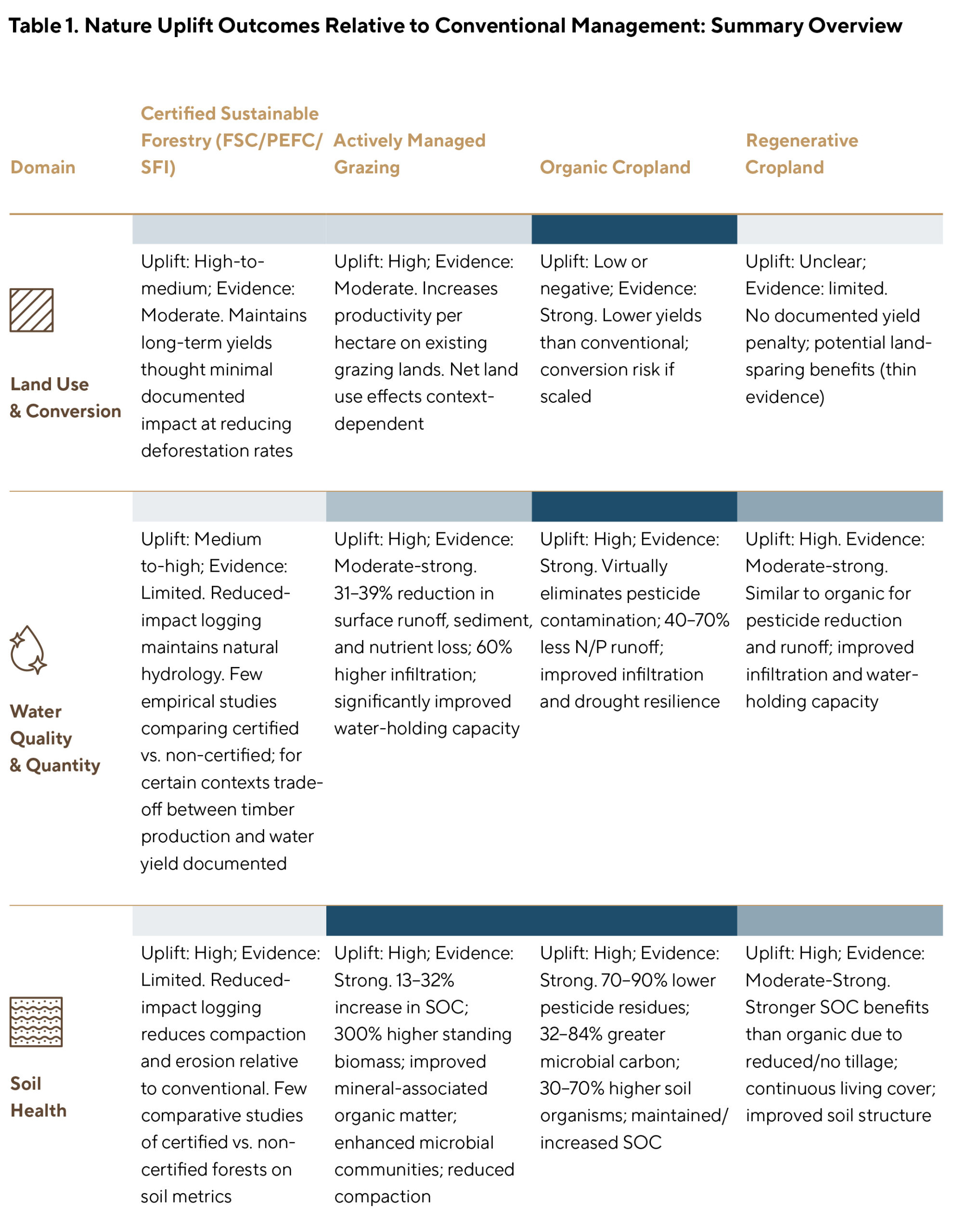
Building on the biological foundations and management approaches described in earlier sections, next we consider the evidence base on comparative performance of sustainable management relative to conventional approaches for timberland, organic/regenerative agriculture, and actively managed grazing lands. Evidence from a review of existing literature, focusing in particular on meta-analyses and broad-scale studies, is presented on the degree of uplift sustainable management regimes have been shown to deliver relative to a conventional management baseline. As noted, leading asset owners already appear to be preferentially seeking verified sustainable production, and so we focus specifically on the type and degree of uplift potential offered by these strategies. For investors interested in maximizing specific or overall positive outcomes for nature, such a review offers a number of useful insights.
Productivity, land use, and productive stability
First, we review available evidence on productivity of sustainable management regimes relative to conventional methods, any well-established associations with land use change, particularly conversion of native ecosystems, and on productive stability, i.e., the resilience of economic yields to disturbances. Given all this, we also consider implications for land use if sustainable management were to scale significantly.
Sustainable forest management’s foundational principle is to harvest at a rate that allows for natural regeneration, and by doing so ensure sustained supply over time. Near-term harvests from sustainably managed forests may be lower compared to conventional logging, but in the long term practices such as thinning dense stands and encouraging regeneration can lead to stronger, larger trees and improved timber volumes, especially when beginning from a degraded baseline. 39 In theory, sustained timber yields as well as integration of other uses (agroforestry, afforestation) should reduce land use change pressures in the form of forest loss for logging, permanent agriculture, urbanization, and other uses. In practice, studies investigating a clear link between forest certification and deforestation have found only minor positive or neutral effects.ii SFM-type approaches are dominant in North America and Europe, where forest area indeed has slightly increased overall since 2000. 40 But at a global level forests continue to be lost, driven to a greater degree by wildfire and agricultural expansion than by unsustainable logging. Thus while SFM appears to support sustainable timber production, it may only be a partial solution to the larger trend of forest loss. 41,42
On grazing lands, there is strong evidence that introducing active management enables increased stocking rates and thus higher productivity per hectare. Intensive grazing management has also been shown to improve productive stability and resilience to extreme weather events.iii In terms of land use change, there is extremely limited peer-reviewed research on the net land use impact of switching to active management on a large scale.iv But given that in many regions, grazing lands are being converted to other uses while demand for protein continues to rise, the implication of gains in per-hectare yields are significant.43,v Meanwhile in tropical regions, where cattle production is a major driver of deforestation, some governments including Brazil and Costa Rica are looking to active and regenerative grazing management approaches to reduce pressure on forests by increasing productivity on existing pasturelands. Institutional investors’ TNFD disclosures increasingly flag cattle as a priority commodity for nature-related risk management, noting that beef and leather supply chains lag behind other forest-risk commodities in deforestation commitments. This creates mounting pressure on consumer staples and discretionary companies to source from verified deforestation-free operations, and amplifying demand for sustainably managed ranchland.
Organic agriculture is typically less productive than intensive conventional agriculture; a recent meta-analysis found units-per-area yields are on average 24% lower. 44 Some research has shown organic outperforms conventional management during times of drought due to improved soil water retention. 45 However, overall lower yields suggest a large-scale transition to organic systems in a given landscape would probably require accepting trade-offs — whether converting more land to agriculture, shifting either conventional production (or calorie deficits) to other regions, or relaxing organic requirements to allow for the use of biotechnology or currently banned nutrient sources (such as mineral fertilizers or human wastes) in order to increase yields. 46,47 As for regenerative (as opposed to organic) agriculture, few broad academic studies exist, but there is no evidence that yields are lower than conventional agriculture, and some indication of improved productivity in specific cases.vi Industry led studies have found greater land use efficiency and higher yields in the range of a 10–30% increase, as well as dramatic improvements in yield stability. 48,vii,viii This adds up to a tantalizing suggestion that a broad-scale shift to regenerative methods broadly could mean less land needed for cropland, but it’s unclear whether these performance results would hold across other crops, climatic regimes, or on large scales. For both organic and regenerative methods, improved crop nutrient density from soil health might have a mitigating effect on land use change, but the effect is hard to isolate.
Water
Forestry, involving road construction/use, site preparation, cultivation, fertilization, and especially felling and harvesting, can have acute negative impacts on water in the short term.ix This includes increased sediment delivery, nutrient and carbon transport, increased water temperatures due to riparian vegetation removal, disruption of natural water cycles, and increased runoff. 49,x Consequently many of the leading forest certifications require use of best management practices such as riparian buffers, low impact logging techniques, and phased felling, which are understood mitigate these impacts significantly. Somewhat surprisingly, very little peer-reviewed evidence exists as to whether certification in practice has actually improved water related outcomes. 50 A trade-off between timber production and water yield has been observed in a number of studies. 51,52,53 Forest plantations, particularly those with fast growing exotic species (Eucalyptus and Pinus spp.) in water-scarce regions, have been shown in multiple geographies to be associated with lower streamflow. 54,55,56,57,58
On grazing lands, there is a strong but relatively small pool of evidence that active management delivers significant water conservation and water quality benefits (31–39% reduction in surface runoff, sediment loss, nitrogen/phosphorus loss) relative to conventional/continuous grazing practices. 59,60 Soil water infiltration is significantly improved and holding capacity is better, primarily through grazing animals’ disrupting the soil surface crusts (“soil caps”) that form in arid environments and impede water penetration. 61,62
Organic and regenerative agriculture clearly outperform conventional agriculture when it comes to pesticide contamination (which is either eliminated or greatly reduced), erosive runoff, and improving soils’ water-holding capacity (and thus resilience during drought). 63,64,65 For other water quality measures, such as nitrate leaching, positive effects are well-documented but highly variable depending on context and practices implemented. 66,67 Apart from water quality impacts, little systematic review of evidence is available when it comes to overall water efficiency or consumption, which depends as much on irrigation methods and climate as on management regime.
Soil health
Soils’ capacity to function as a living system that sustains productivity, regulates water, and supports biodiversity increasingly concerns institutional investors thinking about long-term food system resilience and climate adaptation. Degraded soils require escalating inputs to maintain yields, whereas healthy soils are a buffer against drought, reduce input costs, and sequester carbon.
As with water metrics, few comparative studies specifically compare soil health in certified to non-certified forests, or measure the actual effects of certification. However, there is extensive literature documenting the ways in which conventional logging damages soils (compaction, erosion, nutrient loss) and ample evidence that reduced-impact loggingxi (a core requirement of certifications) reduces these impacts. 68,69,70,71,72
Active grazing management has very strong evidence behind it in terms of reduced bare ground and standing crop biomass (a key metric for soil fertility, which is up to 300% higher where active management approaches are employed). 73 Studies have found 13–32% increases in soil carbon sequestration, including consistent improvements in mineral-associated organic matter (particularly good for stable long-term carbon storage), as well improved soil microbial communities, and food web structure. 74,75,76,77,78,79 Soil compaction is reduced tremendously unless tillage is used on mixed cropland/pastureland. No peer-reviewed comparative studies can be found on pesticide residues but to the extent that producers avoid the application of inorganic fertilizers, herbicides, pesticides, and parasiticides used in conventional grazing management, improvements might be theoretically expected.
Organic agriculture’s clear uplift in terms of pesticide residues is beneficial for soil health as well as water quality. 80 There are also well-documented improvements to soil life abundance/activity relative to conventional. 81,82,83 Regenerative cropland agriculture’s primary focus is soil health; and when regenerative methods are used, soil health outcomes are even better than for organic (largely attributable to organic production using tillage for weed control).
Climate and greenhouse gas emissions
Climate and greenhouse gas profiles present a more complex picture. The evidence base (and, as will be discussed, the appropriate methods for measuring and accounting for outcomes) is still evolving.
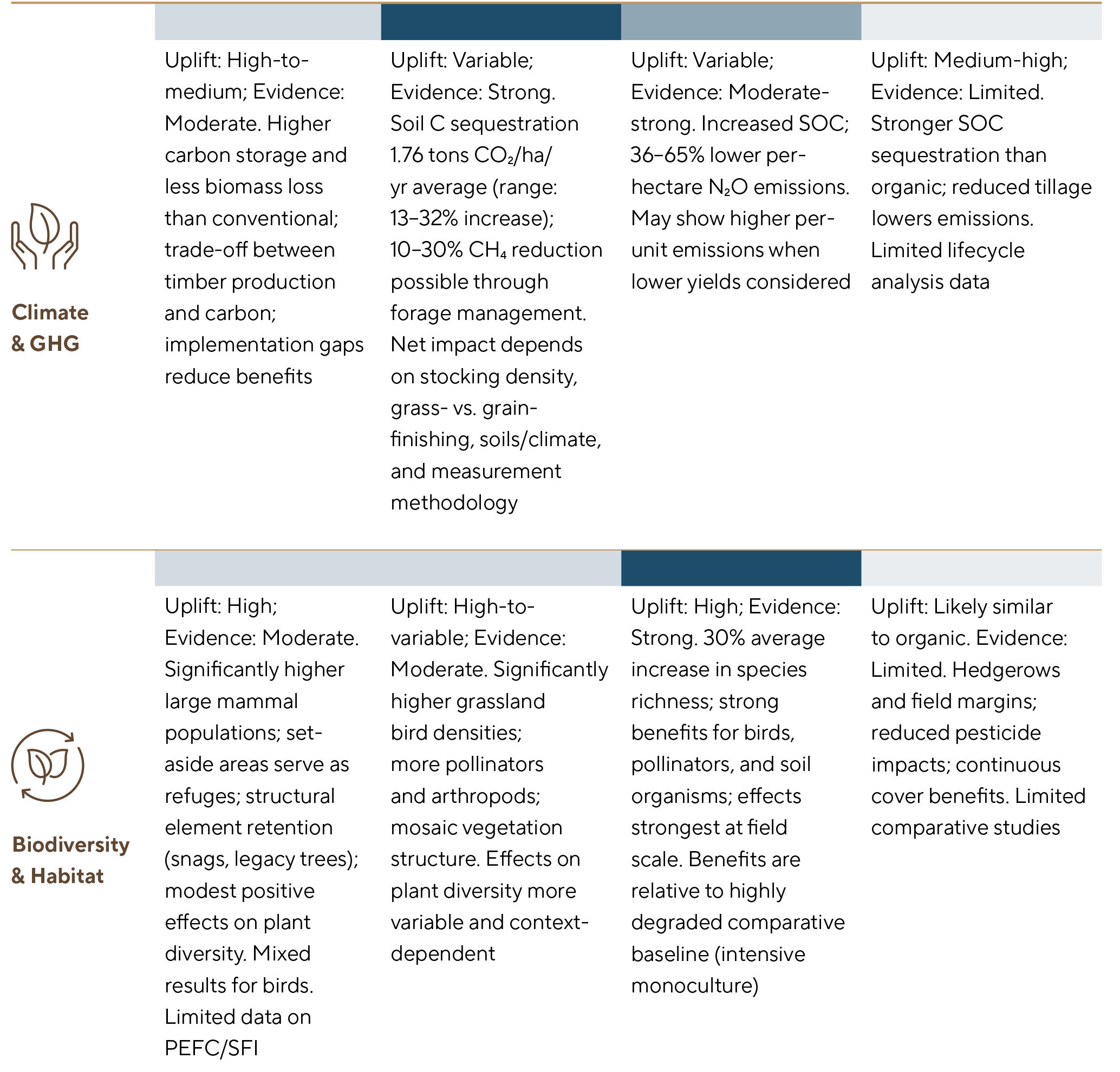
Beginning with forestry, studies on the relationship between carbon stocks and sustainable forest certification and/or reduced-impact logging show a positive effect on carbon storage values with high durability.xii,xiii Sustainable forestry results in less biomass loss and higher above-ground carbon density in remaining vegetation. 84,85,86,87,88,89 Below-ground, there is somewhat less evidence on soil carbon storage, though reduced-impact logging has been shown to result in higher soil carbon levels post-logging. 90 Comparative data on greenhouse gas emissions intensity over the full lifecycle of timber is also limited but one study modeled FSC certification relative to business as usual and found consistently higher carbon storage per unit for FSC-certified timber. 91 Full implementation of SFM practices appears to matter a lot to ensure climate benefits: a study of nine sites in Indonesian Borneo found reduced-impact logging had no meaningful impact on emissions relative to conventional logging because of implementation gaps, 92 while another study showed that SFM’s carbon benefits disappeared when logging occurred before a full 40-year cutting cycle was completed. 93 It should be noted that studies are based on relatively old data and industry practices continue to evolve. As noted earlier, there is also evidence of a tradeoff between managing for timber production versus carbon sequestration, even under SFM. Forest certification bodies are cognizant of the need to more fully integrate and reward climate outcomes in their systems. SFI has launched a new initiative to define and implement climate-smart forestry principles and practices; FSC is developing new tools and instruments to measure and market ecosystem services benefits including carbon.xiv Opportunities to layer revenue from carbon credits are also increasingly being explored by timberland managers, which may tilt incentives further toward a focus on verified climate benefits.
Active grazing management can positively increase soil carbon stocks through the mechanisms of carefully managed grazing and nitrogen management. As noted, studies show uplift in the range of 13–32% more sequestration (or an average of 1.76 tons of CO2/ha/year) 94 than conventionally managed grazing lands, 95,96,97,98,99,xv although sequestration rates are very context-dependent (not to mention methodology-dependentxvi) and great care should be taken in extrapolating to other climates, soil types, and differing management regimes.xvii
On the other hand, since active management supports higher stocking densities, increased methane emissions from more livestock may act as a counterforce to increased soil carbon sequestration. The majority of regenerative ranches also produce grass-fed and/or fully grass-finished beef. Grass-fed beef grow more slowly and have longer lives, meaning they produce more methane than feedlot-finished beef. 100 That said, there are ways to reduce methane emissions by 10–20% by improving forage quality/digestibility through more cool-season forages/legumes and rotational grazing; the IPCC has estimated mitigation potential from such reduced enteric fermentation at 0.12–1.18 GtCO2e/year. 101,102,103
Whether or not active management’s increased soil carbon sequestration outweighs increased enteric methane emissions from livestock (implying that actively managed grazing can be climate-neutral or even climate-positive) has been a matter of recent debate. Available peer-reviewed evidence remains limited, and heavily shaped by both a given study’s on-the-ground context (climate, soil type, history of land use, management practices) and study methodology (how scientists measure carbon in the soil, whether a full lifecycle analysis or more limited scope is used, and assumptions around sequestration rates over time). 104,105,106,107,xviii Some research shows that soil carbon sequestration eclipses increased enteric methane emissions for grass-finished cattle in an active management regime. 108,109 Other studies find that sequestration effects reduce net emissions but do not fully mitigate them. 110,111,112,113 Rowntree et al. (2020) found the net emissions footprint of a regenerative multispecies pasture rotation system was 66% lower than conventional management over a full 20-year lifecycle analysis, but 2.5 times more land was required to maintain production levels. The authors suggest optimizing for food production, land-use, and ecological health ultimately requires weighing the trade-offs between “an input-intensive system that produces more food from a smaller yet degrading land base… [versus producing] less food on a larger, but more ecologically functional landscape.”
The climate accounting also depends critically on measurement. 114 Under the standard GWP100 metric used by international climate bodies, national governments and the Greenhouse Gas Protocol, impacts for all greenhouse gases are averaged over a 100-year period. In reality, methane in the near term (10–20 years) is much more potent than other greenhouse gases but its impact declines relatively quickly. A growing body of science suggests that the GWP100 approach thus underestimates near-term warming and overestimates long-term warming for short-term gases like methane.xix New metrics like GWP* have been proposed that might better reflect the actual temperature change impact of short-lived pollutants. 115 Such approaches, which remain somewhat controversial, suggest that a stable biogenic methane emission rate may not add new warming to the atmosphere, unlike carbon dioxide.116,xx
Finally, organic farming results in higher organic soil carbon (SOC) concentrations and stocks in topsoils than conventional agriculture, ranging from significant to more modest improvements. 117,118,119,120,xxi Agricultural practices also influence SOC: biochar application for example has the strongest positive effect on SOC, while conservation tillage, crop residue retention, and cover crops result in smaller increases in SOC. 121,122 However, to the extent that soil carbon benefits are a function of higher organic matter (i.e., non synthetic fertilizer) application rates, they may not represent additional carbon sequestration but rather simply carbon moving from one site to another. 123 Greenhouse emissions intensity (e.g., emissions produced per unit of economic or operational output) for organic agriculture is more complicated to assess. Nitrous oxide emissions per hectare are clearly lower from organically than non-organically managed soils. 124,125,126 However, when also accounting for organic’s lower per-hectare yields, there is some evidence that on a per-unit basis conventional agriculture actually has lower emissions than organic agriculture. 127
Biodiversity and wildlife habitat
Biodiversity outcomes depend on habitat quality, the variety of niches available for different species, and the connectivity that allows populations to persist. Land management practices differ markedly in their capacity to maintain or restore habitat characteristics supportive of biodiversity, with direct implications for regulatory compliance and ecosystem resilience.
SFM offers clear and strong benefits for mammal diversity, with the effect most pronounced for large mammals and critically endangered species.128,129,130,131 The primary mechanisms are SFM’s use of concessions (set-aside areas focused on high conservation value areas) serving as refuges for species, as well as retention of structural elements in the forest (for example, dead wood/old trees that offer habitat). Within concessions, species richness has been shown to be high; 132,133 but outside of concessions, there may be trade-offs between management for timber and biodiversity conservation. 134 Certification is associated with modest positive effects on plant diversity. There are no clear patterns in differences from conventionally managed forests in terms of taxa abundance or bird diversity. 135 Limited research exists on forest certifications’ impact on broader landscape connectivity, although as noted forests concessions are often important wildlife refuges. Virtually all of the peer-reviewed literature presented here focuses on FSC certification, and is based on studies on the Americas and Europe. Empirical evidence on PEFC’s and SFI’s biodiversity impacts is extremely limited.
Studies examining how actively managed grasslands affect plant diversity and composition are likewise still few in number, and find a variety of results ranging from positive (improved plant composition, a decrease in invasive plants136 and greater plant diversity at a fine spatial scale 137), to mixed (percent of bare ground relative to continuous grazing138), to negative (studies finding an increase in invasive plant species richness and abundance139 and minor reductions in plant diversity and native species richness 140). The range in outcomes may be explained by variations in grazing intensity and timing141 as well as the length of a given study’s time frame in observing long-term shifts in habitat diversity and structure. Insects (arthropods and pollinator communities) meanwhile respond positively to the mosaic of grazed/recovering vegetation heights produced by actively managed grazing approaches.142 Likewise, significantly higher grassland obligate bird densities have been found in these grazing lands, drawn to varied nesting and foraging habitat.143
Meanwhile, three decades’ worth of evidence support organic farming’s positive impacts for species richness (averaging 30% increase relative to conventional) and abundance across taxonomic groups (birds, predatory insects, and soil organisms).144,145,146 There is also good evidence of organic farming supporting pollinator diversity and abundance, although benefits are variable.147 Benefits for species richness are strong at the field level but however fade at the farm or regional level.148 Biodiversity benefits appear to be amplified where organic farms offer refuge from surrounding intensively farmed landscapes. Direct studies of connectivity in organic versus conventional landscapes are limited, but hedgerows, field margins, and wildflower areas may improve landscape permeability for wildlife movement, and organic fields can function as higher-quality matrix habitat between natural areas.
Interpreting evidence on uplift
In reviewing the evidence on uplift from conventional “business as usual,” we need to interpret effects relative to the appropriate baseline. Organic farming improves upon intensive monocultures employing regular application of pesticides: an extremely degraded baseline where almost any biodiversity exists only at field margins. For active grazing management, the baseline is typically a moderately degraded, continuously grazed grassland; introduction of regenerative methods aims to restore ecological function closer to a “natural” state and increase productivity at the same time. Meanwhile, forest certifications often seek to improve upon selective logging in intact forests — a relatively high-functioning baseline where megafauna, canopy structure, and ecosystem processes are often largely intact. From this already-high baseline, improvements may be harder to detect.
In terms of a natural capital investment strategy, or policy decisions writ large, judgment and priorities have to come into play: preventing further degradation of irreplaceable or high-value systems may be seen as more important than incremental improvements to severely degraded systems, even if the evidence of uplift is harder to demonstrate.
As this is a global review, the assessment considers tropical, temperate, and boreal climates as well as (in the context of forests) natural forests and plantations. The evidence base and outcomes can vary tremendously across these categories. Investors will need a good grasp of varying baselines and contexts, methodological debates, and evidence gaps when evaluating certification claims and making allocation decisions that align with their goals.
Summary: Emerging patterns
The evidence reviewed reveals substantial differentiation in nature-related performance across management regimes within each biome type.
Sustainable management’s productivity and yield stability relative to conventional modes, and implications for land use change, vary significantly. Sustainable forestry maintains long-term yields with minimal documented impact on deforestation rates, either for good or for bad. Active grazing management may increase both productive stability and overall productivity per hectare, which may reduce conversion pressure of native ecosystems, but little analysis exists of net land use effects. Organic agriculture, judged solely in terms of yields, is less productive than conventional and has the potential to drive conversion to cropland if scaled. Improved nutrient density may partially mitigate this. Regenerative cropland methods show no yield penalties and some evidence of improved productivity and drought resilience, which could enable land-sparing benefits.
For water, context matters quite a lot, making simple claims about uplift difficult. But consistent evidence indicates that organic agriculture virtually eliminates pesticide contamination and substantially reduces erosive runoff. Active grazing management shows similarly strong evidence for reduced sediment loss and nutrient runoff, plus improved infiltration and water-holding capacity. Sustainable forestry should produce benefits for erosion and pollution control, with more mixed results for streamflows and groundwater. The dearth of empirical evidence on water benefits from sustainable forest certification is notable given forest certification systems are older and more established and explicitly require water protection.
Soil health metrics, increasingly central to sustainable food systems commitments, show strong differentiation. Active grazing management shows pronounced benefits. Soil carbon sequestration increases by 13–32%, with consistent improvements in mineral-associated organic matter, reduced soil compaction, and enhanced microbial food webs. Both organic and regenerative cropland also deliver well-documented improvements: organic agriculture demonstrates 70–90% reductions in pesticide residues alongside significant increases in soil microbial communities. Meanwhile, sustainable forest management (at least using certification as a proxy for SFM implementation) again has a surprisingly weak evidence base, although management strategies to minimize negative soil impacts during harvesting are a core principle.
Biodiversity outcomes vary considerably by context, though clear patterns emerge. Organic cropland consistently delivers 30% increases in species richness across taxonomic groups, at least relative to the extremely degraded baseline of conventional intensive agriculture. FSC-certified forestry shows well-documented benefits for mammal diversity, particularly for large and threatened species, achieved through set-aside areas and retention of structural elements. Actively managed grazing demonstrates clearest benefits for grassland birds, arthropods, and pollinators, while plant community responses are more variable and context-dependent.
Climate and greenhouse gas profiles present a more complex picture. Sustainable forestry produces clear positive effects on carbon storage when properly implemented, though some tradeoffs exist between timber production and carbon optimization. There is a clear evidence base for regenerative/actively managed grazing systems producing substantial soil carbon sequestration benefits, with supporting across-the-fence comparison studies. Net climate impact depends critically on enteric methane emissions, both in terms of how they’re accounted for and management decisions on the ground, where local soils/climate and choices around land usage, forage quality/digestibility, and grass- versus grain-finishing all factor in. Finally, organic cropland increases soil carbon but may show higher per-unit emissions when lower yields are considered.
Several critical caveats apply. Variation within management categories is substantial: climate, soils, land use history, specific practices employed, and species present all profoundly shape outcomes, as discussed. Evidence gaps persist, particularly for water consumption metrics, long-term carbon permanence, and whether reported findings hold at scale. Some strategies are still rapidly evolving.
For investors particularly concerned about specific risks or opportunities, this analysis indicates where strongest evidence exists for meaningful differentiation. Asset allocators should approach certification claims with appropriate scrutiny: the presence of a label does not guarantee empirically verified outcomes, and baseline conditions matter enormously in determining the magnitude of achievable uplift.
Building natural capital portfolios across complementary strategies
These differentiated performance profiles suggest institutional investors might productively think about natural capital allocations through a portfolio lens. Just as financial portfolios balance risk and return across asset classes, a nature portfolio could balance ecological outcomes across biome types, combining sustainable forestry for high-biodiversity conservation value, actively managed grazing for large-scale restoration of degraded lands, and organic/regenerative cropland for supply chain integration and sustainable production goals.
This approach may offer several strategic advantages. It can potentially diversify risk across different biological systems with varying vulnerabilities to climate change, fire, or policy shifts. Additionally, it may allow investors to align different holdings with specific nature targets or disclosure requirements (i.e., some assets contributing to conservation goals, others to restoration, natural climate solutions, or ensuring resilient food/fiber production). And finally, it positions portfolios to potentially capture emerging opportunities as markets for nature-positive products, ecosystem services credits, and climate-smart commodities continue to evolve at different paces across sectors.
Investment viability
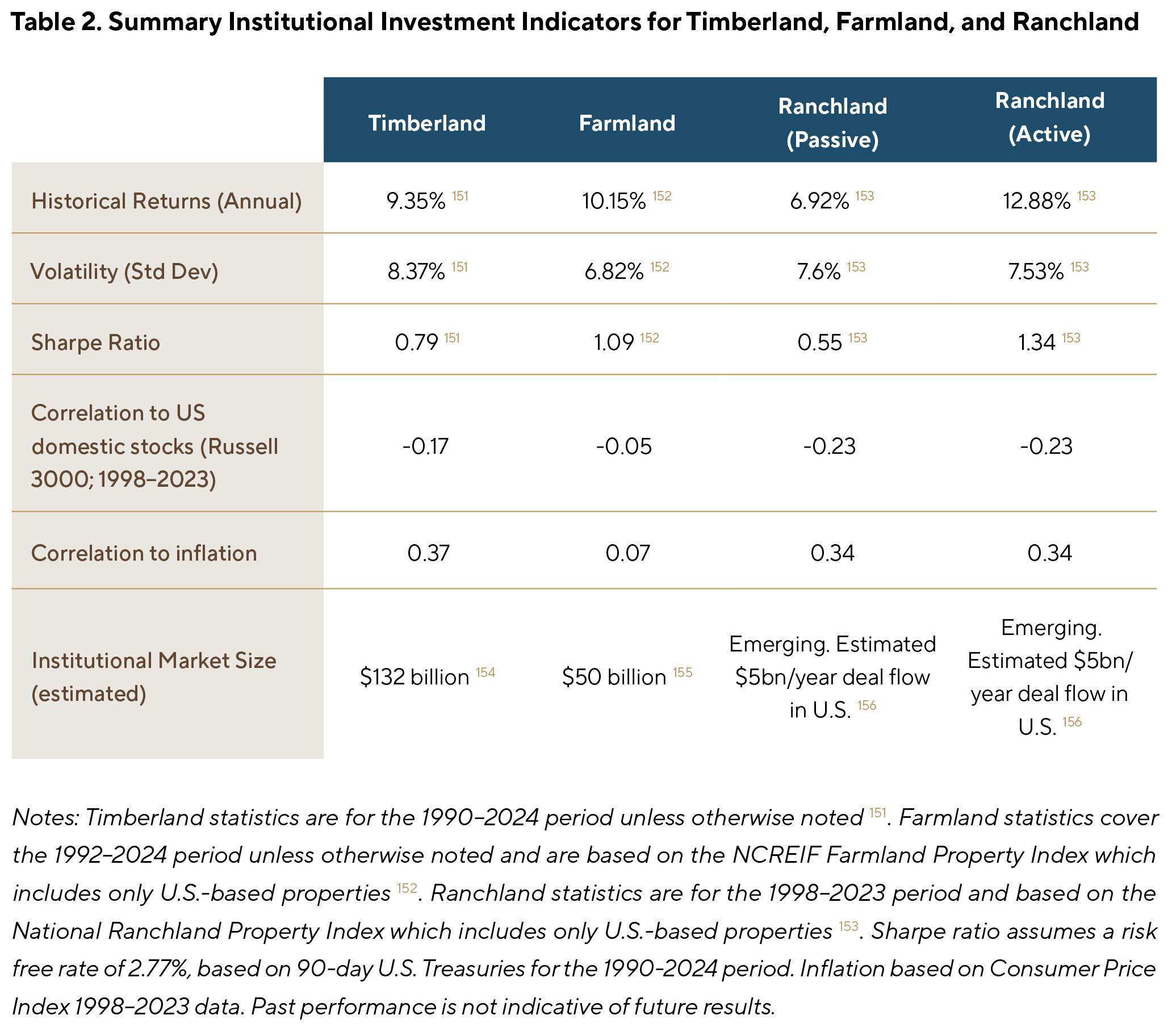
Timberland and farmland are well-established institutional asset classes with decades of performance history and substantial capital deployment. Portfolio characteristics of these asset classes have been well documented elsewhere and are summarized here only briefly. Timberland has attracted approximately $132 billion globally in institutional capital, while estimates of institutional ownership in farmland have reached $50 billion (Table 2). These asset classes demonstrate similar risk-return profiles. Both offer low correlation to traditional assets, inflation hedging properties, stable income streams, and favorable tax treatment through long-term capital gains.
Ranchland exhibits comparable fundamental characteristics to its more mature counterparts but remains an emerging institutional asset class. Ranchland has been largely absent from institutional portfolios due to fragmented deal flow, operational complexity, and limited professional management infrastructure. The landscape is shifting dramatically: in the United States, over 96% of ranchland properties are expected to change hands over the next 30 years due to generational transfers, and large-scale properties (defined as greater than $15M in value) representing 25% of total acreage are now becoming accessible to institutional capital. 149 Pastureland values have also demonstrated consistent appreciation, reflecting growing institutional recognition of grazing lands as a viable asset class. 150
Potential contributions to global goals for nature
SFM, actively managed grazing, and organic/regenerative cropland agriculture each vary in their potential to contribute across Target 2 (“Restore 30% of all degraded ecosystems”), Target 3 (“Conserve 30% of land, waters, and seas”) and Target 10 (“Enhance biodiversity and sustainability in agriculture, aquaculture, fisheries, and forestry”). It’s beyond the scope of this paper to evaluate each system’s overall potential to support GBF Targets, but worth discussing in brief what is implied by our review (Table 3).
Certified SFM offers moderate to high restoration potential (Target 2) depending on the initial state of the forest (i.e., on whether certified forests are already high-quality ecosystems or in a degraded state); and by the same token offers very high conservation value per hectare (Target 3) in maintaining irreplaceable biodiversity.
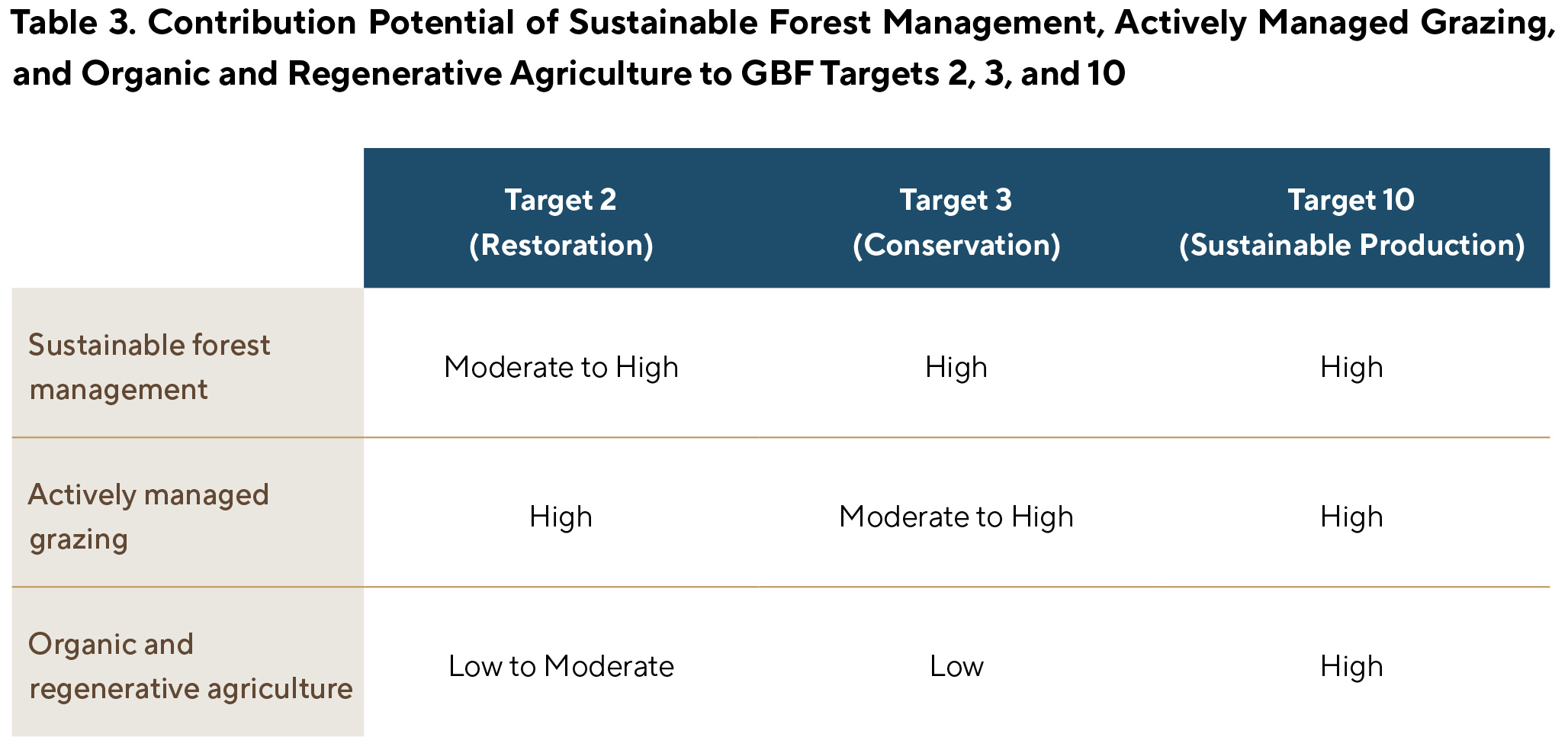
Actively managed grazing meanwhile aligns strongly with Target 2, given the evidence that degraded grasslands can recover substantial ecological functionality when active/regenerative approaches are introduced. Actively managed grasslands may also contribute to Target 3 depending on specific management practices and whether grasslands meet the criteria to be considered an Other Effective Area-Based Conservation Measure (OECM).
All three systems contribute to Target 10 (Sustainable Production), albeit with different levels of third party certification widely available. Organic and regenerative cropland also offers some Target 2 restoration potential in terms of soil health and some biodiversity, but within the more limited context of cropland rather than natural or semi-natural ecosystems like forests and grasslands.
Conclusion
As disclosure frameworks mature, investors need evidence-based understanding of which strategies deliver measurable outcomes on specific metrics of interest. The evidence summarized in this report may be helpful in considering new allocations to natural capital or evaluating current ones. This analysis shows substantial differentiation exists, grounded in fundamental biological characteristics (think for example of forests’ vertical complexity, grasslands’ belowground resilience, or croplands’ annual disturbance regime) that create distinct constraints and opportunities which are then shaped by management choices. No single strategy optimizes across all dimensions.
A portfolio approach to natural capital may allow asset managers to balance trade-offs across strategies, for example combining timberland’s conservation value for threatened species with cropland’s supply chain integration potential and grassland’s restoration scalability, while at the same time managing risks associated with sector-specific climate impacts, regulatory changes, and market development that vary significantly across forestry, agriculture, and grazing lands. Success will require constructing portfolios suited to their own priorities, commitments, and risk exposures; understanding appropriate baselines and methodological issues for each system; ensuring robust monitoring and verification of nature-related claims; and maintaining the flexibility to adjust allocations as evidence, markets, and disclosure frameworks continue to evolve.
Footnotes
i. The relative level of biomass accumulation varies tremendously by forest type, age, and climate; tropical and temperate forests maintain higher amounts than boreal forests.
ii. Droge et al (2025) note that their analysis was limited by the “lack of publicly available data on certified forests at high spatial resolution and the use of aggregated country-level certification coverage, which might obscure regional (subcountry) effects.”
iii. Delandmeter et al. (2025) in a recent study find heavy-moderate grazing as part of an integrated cropland-livestock system, compared to a range of agricultural management approaches, was second only in economic performance to corn monocropping and outperformed it in cold, lower-yield locations within the study’s US Midwestern scope of analysis.
iv. Rowntree et al. (2020) find that grass-finishing cattle on actively managed grazing lands appears to require more land than conventional systems. This is because cattle on feedlots eat grains with higher energy density than grass. However, that study also suggests there is a trade-off between optimizing for soil carbon sequestration versus land use, discussed later in this paper.
v. In the United States for instance there was a 13% decline in acreage dedicated to pasturelands in the 25-year period 1997–2022 (USDA National Agriculture Statistics Service, accessed 2025).
vi. Jordan et al., 2022. The authors noted their analysis was limited by a low number of studies assessing outcomes of implementing multiple regenerative practices simultaneously, as is common in regenerative agriculture “systems.”
vii. Some studies suggest an initial transition period exists ranging from one to five years where crop yields initially fall. See for example Petry et al. (2023).
viii. Stockdale et al. (2024) in a long-term study of corn and soy in the United States Corn Belt suggests that during years of drought, when a conventional farm might achieve only one-third of its typical yield, farms that practice no-till farming and plant cover crops could maintain more than 95% of their usual yield.
ix. Temporal and spatial scale of measurement matter a lot in assessing impact, which may partially explain the range of outcomes shown in the literature.
x. It should also be noted that other land uses (agriculture, pastureland) have been shown to deliver far higher levels of sediment to waterways than forest operations (Welsch, 1991).
xi. Reduced-impact logging methods aim to minimize environmental damages from logging, and typically include practices such as extensive pre-planning (forest inventories, careful planning of roads and skid trails), directional felling, selective logging, and establishment of buffer zones around streams.
xii. Wolff and Schweinle, 2022. Exceptions exist: Foster et al. (2008) compared standards harvested to FSC standards to noncertified harvested stands in Vermont and found similar aboveground carbon storage values and live tree structure, but more residual coarse wood debris at the certified sites.
xiii. It is important to note that differences in biomass loss or carbon stocks between sustainable forests and conventionally managed forests are hard to clearly compare. Since reduced impact logging tends to be associated with lower logging intensity, distinguishing between the effects of logging intensity versus logging method is challenging, and differences in biomass loss may be attributable to the former, not the latter (Martin et al., 2015, Putz et al., 2012).
xiv. Author’s disclosure: Genevieve Bennett was lead author on a study conducted for FSC in 2016 evaluating potential supply and demand for verified ecosystem services benefits from responsibly managed forests.
xv. A meta-analysis of studies on Australian grazing lands by MacDonald et al. (2023) found limited direct evidence attributing soil carbon increases to grazing management, although it noted that grazing management practices could positively support drivers of soil carbon sequestration: increased plant cover, more standing crop biomass enabling rapid recovery from disturbances, and/or shifts toward perennial pasture species with greater belowground biomass allocation.
xvi. Outcomes are also influenced by study boundaries (on-ranch versus supply chain or full life cycle), assumptions around the permanence of sequestration, and time horizons. See for example Bai and Cotrufo (2022) and Godde et al. (2020).
xvii. Estimates of the overall cost-effective carbon sequestration potential of introducing improved grazing management in global grasslands worldwide range from 37–2090 megatons in the peer-reviewed literature, (Batjes, 2019; Smith et al., 2008) although some researchers have questioned the methodological assumptions and socio-economic practicalities of scaling at that level (Godde et al, 2020).
xviii. As Jordan et al. (2022) observe, the debate is also driven by ideological positions and vested interests — not just scientific uncertainty.
xix. A key ongoing debate is whether relying on carbon dioxide sequestered in soil to offset ongoing methane emissions is or is not a durable long-term solution. [See for example Wang et al. (2023),] The appropriateness of GWP100 is one key methodological issue; another is whether increased soil carbon sequestration is a relatively short-lived benefit (increasing for several decades before effectively reaching capacity and a new equilibrium state). While the idea of a maximum capacity for soil carbon saturation has theoretical support, recent comprehensive reviews find that evidence for its practical importance is “limited and contradictory” and probably highly context-dependent. (Georgiou, Katerina, et al. “Soil carbon saturation: what do we really know?.” Global Change Biology 31.5 (2025): e70197.)
xx. GWP* remains controversial and is not yet used in official climate accounting or in ISO-approved life cycle analysis methodologies, but is mentioned here since it highlights how profoundly the choice of methodological approach influences whether active grazing management is net climate-beneficial or climate-harmful.
xxi. Soil organic carbon storage is shaped by a range of factors including soil pH, soil texture, and air temperature, which helps explain the variation in findings across studies.
References
- Pollination. 2025. Nature Finance focus: Tracking Global Trends in Nature Investment. https://pollinationgroup.com/wp-content/uploads/2025/07/Pollintaion_NFF_2025__Final.pdf
- von Braun, Joachim; Meinzen-Dick, Ruth Suseela. 2009. Land grabbing by foreign investors in developing countries. IFPRI Policy Brief 13. https://hdl.handle.net/10568/161806. See for example Houben (2024).
- See for example Houben (2024).
- Jacobs, S., and P. Buff. May 2024. “Biodiversity bonds: the new frontier in fixed income markets.” Pictet Asset Management.
- Mordor Intelligence. 2025. Green Bonds Market Size & Share Analysis. Hyderabad: Mordor Intelligence.
- bfinance. 2024. Natural Capital Investing: Forestry, Agriculture and Carbon Credits. London: bfinance.
- Dreaneen, A. 13 September 2023. “Investing in nature at scale — can it be done?” Environmental Finance.
- King, J., T. Bromfield, I. Milborrow. 2023. Accelerating Finance for Nature: Barriers and recommendations for scaling private sector investment. PwC Centre for Nature Positive Business. Retrieved from
https://www.pwc.com/gx/en/issues/esg/nature-and-biodiversity/closing-the-nature-investment-gap.html. - UNEP. 2021. Rangelands Atlas. Accessed at https://www.rangelandsdata.org/atlas/.
- Shukla, P.R., J. Skea, R. Slade, R. van Diemen, E. Haughey, J. Malley, M. Pathak, J. Portugal Pereira (eds.) Technical Summary, 2019. In: Climate Change and Land: an IPCC special report on climate change, desertification, land degradation, sustainable land management, food security, and greenhouse gas fluxes in terrestrial ecosystems [P.R. Shukla, J. Skea, E. Calvo Buendia, V. Masson-Delmotte, H.-O. Pörtner, D. C. Roberts, P. Zhai, R. Slade, S. Connors, R. van Diemen, M. Ferrat, E. Haughey, S. Luz, S. Neogi, M. Pathak, J. Petzold, J. Portugal Pereira, P. Vyas, E. Huntley, K. Kissick, M, Belkacemi, J. Malley, (eds.)]. https://doi.org/10.1017/9781009157988.002
- Dass, P., Houlton, B. Z., Wang, Y. & Warlind, D. 2018. “Grasslands may be more reliable carbon sinks than forests in California.” Environmental Research Letters. 13, 074027.
- Rozendaal, Danaë MA, et al. “Aboveground forest biomass varies across continents, ecological zones and successional stages: Refined IPCC default values for tropical and subtropical forests.” Environmental Research Letters 17.1 (2022): 014047.
- Keith, H., Mackey, B. G., & Lindenmayer, D. B. (2009). “Re-evaluation of forest biomass carbon stocks and lessons from the world’s most carbon-dense forests.” Proceedings of the National Academy of Sciences, 106(28), 11635–11640.
- Ma, Haozhi, et al. “The global distribution and environmental drivers of aboveground versus belowground plant biomass.” Nature Ecology & Evolution 5.8 (2021): 1110–1122.
- Bolinder, M. A., Janzen, H. H., Gregorich, E. G., Angers, D. A., & VandenBygaart, A. J. “An approach for estimating net primary productivity and annual carbon inputs to soil for common agricultural crops in Canada.” Agriculture, Ecosystems & Environment, 118(1–4) (2007): 29–42.
- Pausas, Juli G., and Jon E. Keeley. “Wildfires as an ecosystem service.” Frontiers in Ecology and the Environment 17.5 (2019): 289–295.
- Bond, William J., and Jon E. Keeley. “Fire as a global ‘herbivore’: the ecology and evolution of flammable ecosystems.” Trends in Ecology & Evolution 20.7 (2005): 387–394.
- Collins, Scott L., and Laura B. Calabrese. “Effects of fire, grazing and topographic variation on vegetation structure in tallgrass prairie.” Journal of Vegetation Science 23.3 (2012): 563–575.
- Dass, P., Houlton, B. Z., Wang, Y. & Warlind, D. 2018. “Grasslands may be more reliable carbon sinks than forests in California.” Environmental Research Letters 13, 074027.
- Calder, Ian R. “Forests and water—ensuring forest benefits outweigh water costs.” Forest Ecology and Management 251.1–2 (2007): 110–120.
- Ilstedt, Ulrik, et al. “The effect of afforestation on water infiltration in the tropics: a systematic review and meta-analysis.” Forest Ecology and Management 251.1–2 (2007): 45–51.
- Hamza, M. A., and Walter K. Anderson. “Soil compaction in cropping systems: A review of the nature, causes and possible solutions.” Soil and Tillage Research 82.2 (2005): 121–145.
- Skaggs, R. Wayne, M. A. Breve, and J. W. Gilliam. “Hydrologic and water quality impacts of agricultural drainage*.” Critical Reviews in Environmental Science and Technology 24.1 (1994): 1–32.
- Chapin III, F. S., P.A. Matson, and P. Vitousek. Principles of Terrestrial Ecosystem Ecology (2nd edition). New York, NY: Springer New York, 2011.
- Knapp, Alan K., et al. “The keystone role of bison in North American tallgrass prairie: Bison increase habitat heterogeneity and alter a broad array of plant, community, and ecosystem processes.” BioScience 49.1 (1999): 39–50.
- Augustine, David J., and Douglas A. Frank. “Effects of migratory grazers on spatial heterogeneity of soil nitrogen properties in a grassland ecosystem.” Ecology 82.11 (2001): 3149–3162.
- Vitousek, Peter M., et al. “Human alteration of the global nitrogen cycle: sources and consequences.” Ecological Applications 7.3 (1997): 737–750.
- Carpenter, Stephen R., et al. “Nonpoint pollution of surface waters with phosphorus and nitrogen.” Ecological Applications 8.3 (1998): 559–568.
- Franklin, Jerry F., et al. “Disturbances and structural development of natural forest ecosystems with silvicultural implications, using Douglas-fir forests as an example.” Forest Ecology and Management 155.1–3 (2002): 399–423.
- Paillet, Yoan, et al. “Biodiversity differences between managed and unmanaged forests: Meta-analysis of species richness in Europe.” Conservation Biology 24.1 (2010): 101–112.
- Lindenmayer, David B., Chris R. Margules, and Daniel B. Botkin. “Indicators of biodiversity for ecologically sustainable forest management.” Conservation Biology 14.4 (2000): 941–950.
- Knapp, Alan K., et al. “The keystone role of bison in North American tallgrass prairie: Bison increase habitat heterogeneity and alter a broad array of plant, community, and ecosystem processes.” BioScience 49.1 (1999): 39–50.
- Hobbs, N. Thompson. “Modification of ecosystems by ungulates.” The Journal of Wildlife Management (1996): 695–713.
- Augustine, David J., and Douglas A. Frank. “Effects of migratory grazers on spatial heterogeneity of soil nitrogen properties in a grassland ecosystem.” Ecology 82.11 (2001): 3149–3162.
- Samson, Fred B., Fritz L. Knopf, and Wayne R. Ostlie. “Great Plains ecosystems: past, present, and future.” Wildlife Society Bulletin 32.1 (2004): 6–15.
- Ceballos, Gerardo, et al. “Rapid decline of a grassland system and its ecological and conservation implications.” PloS one 5.1 (2010): e8562.
- Benton, Tim G., Juliet A. Vickery, and Jeremy D. Wilson. “Farmland biodiversity: is habitat heterogeneity the key?.” Trends in Ecology & Evolution 18.4 (2003): 182–188.
- Tscharntke, Teja, et al. “Landscape perspectives on agricultural intensification and biodiversity–ecosystem service management.” Ecology Letters 8.8 (2005): 857–874.
- Putz, Francis E., et al. “Sustained timber yield claims, considerations, and tradeoffs for selectively logged forests.” PNAS Nexus 1.3 (2022): pgac102.
- FAO. 2025. Global Forest Resources Assessment 2025. Rome.
- Tyukavina et al. Congo Basin forest loss dominated by increasing smallholder clearing. Sci. Adv. 4, eaat2993 (2018). DOI:10.1126/sciadv.aat2993
- Sims, Michelle J., et al. “Global drivers of forest loss at 1 km resolution.” Environmental Research Letters (2024).
- Godde, Cécile M., et al. “Grazing systems expansion and intensification: Drivers, dynamics, and trade-offs.” Global Food Security 16 (2018): 93–105.
- Colombi, Greta, Enrico Martani, and Dario Fornara. “Regenerative organic agriculture and soil ecosystem service delivery: A literature review.” Ecosystem Services 73 (2025): 101721.
- Pimentel, David, et al. Organic and conventional farming systems: Environmental and Economic Issues. 2005.
- Rasche, L., Steinhauser, J. How will an increase in organic agricultural area affect land use in Germany?. Org. Agr. 12, 513–530 (2022). https://doi.org/10.1007/s13165–022-00405–2
- Meemken, Eva-Marie, and Matin Qaim. “Organic agriculture, food security, and the environment.” Annual Review of Resource Economics 10.1 (2018): 39–63.
- Stockdale, O., P. Prabhala, T. Brennan, and R. Chen. 2024. “Revitalizing fields and balance sheets through regenerative farming.” McKinsey & Company. Accessed 11 November 2025. https://www.mckinsey.com/industries/agriculture/our-insights/revitalizing-fields-and-balance-sheets-through-regenerative-farming
- Shah, Nadeem W., et al. “The effects of forest management on water quality.” Forest Ecology and Management 522 (2022): 120397.
- Wilson, David C., Michael A. Kilgore, and Stephanie A. Snyder. “Examining the effect of forest certification on timber harvest best management practice implementation.” International Journal of Forest Engineering 36.1 (2025): 20–28.
- Putz, Francis E., and Michelle A. Pinard. “Reduced-impact logging as a carbon-offset method.” Conservation Biology 7.4 (1993): 755–757.
- Diaz, David D., et al. “Tradeoffs in timber, carbon, and cash flow under alternative management systems for Douglas-Fir in the Pacific Northwest.” Forests 9.8 (2018): 447.
- Cademus, Ronald, et al. “Analyzing trade-offs, synergies, and drivers among timber production, carbon sequestration, and water yield in Pinus elliotii forests in southeastern USA.” Forests 5.6 (2014): 1409–1431.
- Ibid.
- Little, Christian, et al. “Revealing the impact of forest exotic plantations on water yield in large scale watersheds in South-Central Chile.” Journal of Hydrology 374.1–2 (2009): 162–170.
- Lara, Antonio, et al. “Assessment of ecosystem services as an opportunity for the conservation and management of native forests in Chile.” Forest Ecology and Management 258.4 (2009): 415–424.
- Calder, Ian R. “Forests and water—ensuring forest benefits outweigh water costs.” Forest Ecology and Management 251.1–2 (2007): 110–120.
- Scott, David F. “On the hydrology of industrial timber plantations.” Hydrological Processes (2005): 4203–4206. https://doi.org/10.1002/hyp.6104
- Park, J. Y., et al. “Simulating hydrologic responses to alternate grazing management practices at the ranch and watershed scales.” Journal of Soil and Water Conservation 72.2 (2017): 102–121.
- Teague, Richard, and Urs Kreuter. “Managing grazing to restore soil health, ecosystem function, and ecosystem services.” Frontiers in Sustainable Food Systems 4 (2020): 534187.
- Apfelbaum, Steven I., et al. “Vegetation, water infiltration, and soil carbon response to Adaptive Multi-Paddock and Conventional grazing in Southeastern USA ranches.” Journal of Environmental Management 308 (2022): 114576.
- Döbert, Timm F., et al. “Adaptive multi-paddock grazing improves water infiltration in Canadian grassland soils.” Geoderma 401 (2021): 115314.
- Vincent, Audrey & Fleury, Philippe. “Development of organic farming for the protection of water quality: Local projects in France and their policy implications.” Land Use Policy. 43 (2015): 197–206. 10.1016/j.landusepol.2014.10.020.
- Lankford, Bruce, and Stuart Orr. “Exploring the critical role of water in regenerative agriculture; building promises and avoiding pitfalls.” Frontiers in Sustainable Food Systems 6 (2022): 891709.
- Pimentel, David, et al. Organic and conventional farming systems: Environmental and Economic Issues. 2005.
- Sivaranjani, S., and Amitava Rakshit. “Organic farming in protecting water quality.” Organic farming: new advances towards sustainable agricultural systems (2019): 1–9.
- Vincent, Audrey & Fleury, Philippe. “Development of organic farming for the protection of water quality: Local projects in France and their policy implications.” Land Use Policy. 43 (2015): 197–206. 10.1016/j.landusepol.2014.10.020.
- Feldpausch, Ted R., et al. “When big trees fall: damage and carbon export by reduced impact logging in southern Amazonia.” Forest Ecology and Management 219.2–3 (2005): 199–215.
- Medjibe, Vincent P., Francis E. Putz, and Claudia Romero. “Certified and uncertified logging concessions compared in Gabon: changes in stand structure, tree species, and biomass.” Environmental Management 51.3 (2013): 524–540.
- Asner, Gregory P., et al. “Canopy damage and recovery after selective logging in Amazonia: field and satellite studies.” Ecological Applications 14.sp4 (2004): 280–298.
- Bertault, Jean-Guy, and Plinio Sist. “An experimental comparison of different harvesting intensities with reduced-impact and conventional logging in East Kalimantan, Indonesia.” Forest Ecology and Management 94.1–3 (1997): 209–218.
- Sist, Plinio, et al. “Reduced-impact logging in Indonesian Borneo: some results confirming the need for new silvicultural prescriptions.” Forest Ecology and Management 179.1–3 (2003): 415–427.
- Apfelbaum, Steven I., et al. “Vegetation, water infiltration, and soil carbon response to Adaptive Multi-Paddock and Conventional grazing in Southeastern USA ranches.” Journal of Environmental Management 308 (2022): 114576.
- Mosier, Samantha, et al. “Adaptive multi-paddock grazing enhances soil carbon and nitrogen stocks and stabilization through mineral association in southeastern US grazing lands.” Journal of Environmental Management 288 (2021): 112409.
- Apfelbaum, Steven I., et al. “Vegetation, water infiltration, and soil carbon response to Adaptive Multi-Paddock and Conventional grazing in Southeastern USA ranches.” Journal of Environmental Management 308 (2022): 114576.
- Stanley, P.L., Rowntree, J.E., Beede, D.K., DeLonge, M.S., & Hamm, M.W. (2018). Impacts of soil carbon sequestration on life cycle greenhouse gas emissions in Midwestern USA beef finishing systems. Agricultural Systems, 162, 249–258.
- Johnson, David C., et al. “Adaptive multi-paddock grazing management’s influence on soil food web community structure for: increasing pasture forage production, soil organic carbon, and reducing soil respiration rates in southeastern USA ranches.” PeerJ 10 (2022): e13750.
- Mehre, A. A., Liang, C., & Bork, E. W.” Adaptive multi-paddock grazing increases soil carbon stocks and decreases the carbon footprint of beef production in Ontario, Canada.” Journal of Environmental Management, 350 (2024), 119382
- Montgomery DR, Biklé A, Archuleta R, Brown P, Jordan J. “Soil health and nutrient density: preliminary comparison of regenerative and conventional farming.” PeerJ (2022): 10:e12848 https://doi.org/10.7717/peerj.12848
- Colombi, Greta, Enrico Martani, and Dario Fornara. “Regenerative organic agriculture and soil ecosystem service delivery: A literature review.” Ecosystem Services 73 (2025): 101721.
- Ibid.
- Krause, Hans-Martin, et al. “Organic cropping systems balance environmental impacts and agricultural production.” Scientific Reports 14.1 (2024): 25537.
- Chmelíková, Lucie, et al. “Nitrogen-use efficiency of organic and conventional arable and dairy farming systems in Germany.” Nutrient Cycling in Agroecosystems 119.3 (2021): 337–354. Agroecosystems 119.3 (2021): 337–354.
- Wolff S, Schweinle J. “Effectiveness and Economic Viability of Forest Certification: A Systematic Review.” Forests. 2022; 13(5):798. https://doi.org/10.3390/f13050798
- Medjibe, Vincent P., Francis E. Putz, and Claudia Romero. “Certified and uncertified logging concessions compared in Gabon: changes in stand structure, tree species, and biomass.” Environmental Management 51.3 (2013): 524–540.
- Sollmann, Rahel, et al. “Quantifying mammal biodiversity co-benefits in certified tropical forests.” Diversity and Distributions 23.3 (2017): 317–328.
- Imai, Nobuo, et al. “Co-benefits of sustainable forest management in biodiversity conservation and carbon sequestration.” PloS one 4.12 (2009): e8267.
- Putz, Francis E., and Michelle A. Pinard. “Reduced-impact logging as a carbon-offset method.” Conservation Biology 7.4 (1993): 755–757.
- Forest Stewardship Council. “Toward climate smart forestry: Increasing carbon storage in the working forests of Canada and the United States.” 2023. FSC-United States.
- Putz, Francis E., and Michelle A. Pinard. “Reduced-impact logging as a carbon-offset method.” Conservation Biology 7.4 (1993): 755–757.
- Diaz, David D., et al. “Tradeoffs in timber, carbon, and cash flow under alternative management systems for Douglas-Fir in the Pacific Northwest.” Forests 9.8 (2018): 447.
- Griscom, Bronson & Ellis, Peter & Burivalova, Zuzana & Halperin, James & Marthinus, Delon & Runting, Rebecca & Ruslandi, Ruslandi & Shoch, David & Putz, F.E. “Reduced-impact logging in Borneo to minimize carbon emissions and impacts on sensitive habitats while maintaining timber yields.” Forest Ecology and Management. 438 (2019): 176–185. 10.1016/j.foreco.2019.02.025.
- Sasaki, N., & Putz, F.E. Sustainable Management of Tropical Forests Can Reduce Carbon Emissions and Stabilize Timber Production. Frontiers in Environmental Science, 4, 50 (2016).
- Conant RT, Cerri CEP, Osborne BB, Paustian K. “Grassland management impacts on soil carbon stocks: a new synthesis.” Ecol Appl 27 (2017):662–668. https://doi.org/10.1002/eap.1473
- Stanley, P.L., Rowntree, J.E., Beede, D.K., DeLonge, M.S., & Hamm, M.W. “Impacts of soil carbon sequestration on life cycle greenhouse gas emissions in Midwestern USA beef finishing systems.” Agricultural Systems, 162, (2018): 249–258.
- Ibid.
- Apfelbaum, Steven I., et al. “Vegetation, water infiltration, and soil carbon response to Adaptive Multi-Paddock and Conventional grazing in Southeastern USA ranches.” Journal of Environmental Management 308 (2022): 114576.
- Liu, Yazhou, et al. “The impact of different grazing intensity and management measures on soil organic carbon density in Zhangye grassland.” Scientific Reports 14.1 (2024): 17556..
- Stanley, Paige, Leslie Roche, and Timothy Bowles. “Amping up soil carbon: soil carbon stocks in California rangelands under adaptive multi-paddock and conventional grazing management.” International Journal of Agricultural Sustainability 23.1 (2025): 2461826.
- Stanley, P.L., Rowntree, J.E., Beede, D.K., DeLonge, M.S., & Hamm, M.W. “Impacts of soil carbon sequestration on life cycle greenhouse gas emissions in Midwestern USA beef finishing systems.” Agricultural Systems, 162, (2018): 249–258.
- Thompson, L. R., and J. E. Rowntree. “Invited review: Methane sources, quantification, and mitigation in grazing beef systems.” Applied Animal Science 36.4 (2020): 556–573.
- Wang, T., Teague, W., Park, S., and Bevers, S. “GHG mitigation potential of different grazing strategies in the United States southern great plains.” Sustainability 7, (2015): 13500–13521. doi: 10.3390/su71013500
- Shukla, P.R., J. Skea, R. Slade, R. van Diemen, E. Haughey, J. Malley, M. Pathak, J. Portugal Pereira (eds.), Technical Summary, 2019. In: Climate Change and Land: an IPCC special report on climate change, desertification, land degradation, sustainable land management, food security, and greenhouse gas fluxes in terrestrial ecosystems [P.R. Shukla, J. Skea, E. Calvo Buendia, V. Masson-Delmotte, H.-O. Pörtner, D. C. Roberts, P. Zhai, R. Slade, S. Connors, R. van Diemen, M. Ferrat, E. Haughey, S. Luz, S. Neogi, M. Pathak, J. Petzold, J. Portugal Pereira, P. Vyas, E. Huntley, K. Kissick, M, Belkacemi, J. Malley, (eds.)], 2019. https://doi.org/10.1017/9781009157988.002
- Jordon et al. 2022. “Temperate Regenerative Agriculture practices increase soil carbon but not crop yield—a meta-analysis.” Environmental Research Letters. Vol 17 No 9. (2022). doi 10.1088/1748–9326/ac8609
- Stanley, P.L., Rowntree, J.E., Beede, D.K., DeLonge, M.S., & Hamm, M.W. “Impacts of soil carbon sequestration on life cycle greenhouse gas emissions in Midwestern USA beef finishing systems.” Agricultural Systems, 162, (2018): 249–258.
- Wang, Tong, et al. “GHG mitigation potential of different grazing strategies in the United States Southern Great Plains.” Sustainability 7.10 (2015): 13500–13521.
- Stanley, Paige, et al. “Valid inferences about soil carbon in heterogeneous landscapes.” Geoderma 430 (2023): 116323.
- Rowntree, Jason E., et al. “Ecosystem impacts and productive capacity of a multi-species pastured livestock system.” Frontiers in Sustainable Food Systems 4 (2020): 544984.
- Stanley, P.L., Rowntree, J.E., Beede, D.K., DeLonge, M.S., & Hamm, M.W. Impacts of soil carbon sequestration on life cycle greenhouse gas emissions in Midwestern USA beef finishing systems. Agricultural Systems, 162, (2018): 249–258.
- Hillenbrand, Mimi, et al. “Impacts of holistic planned grazing with bison compared to continuous grazing with cattle in South Dakota shortgrass prairie.” Agriculture, Ecosystems & Environment 279 (2019): 156–168.
- Machmuller, M. B., Kramer, M. G., Cyle, T. K., Hill, N., Hancock, D., and Thompson, A. “Emerging land use practices rapidly increase soil organic matter.” Nature Communications 6:6995 (2015). doi: 10.1038/ncomms7995
- Pierrehumbert, R. T., and Eshel, G. “Climate impact of beef: an analysis considering multiple time scales and production methods without use of global warming potentials.” Environ. Res. Lett. 10:085002 (2015). doi: 10.1088/1748–9326/10/8/085002
- Wang, T., Teague, W., Park, S., and Bevers, S. (2015). GHG mitigation potential of different grazing strategies in the united states southern great plains. Sustainability 7, 13500–13521. doi: 10.3390/su71013500
- Thompson, L. R., et al. “Is climate neutral possible for the US beef and dairy sectors?.” Frontiers in Sustainable Food Systems 9 (2025): 1556433.
- Allen, Myles R., et al. “A solution to the misrepresentations of CO2-equivalent emissions of short-lived climate pollutants under ambitious mitigation.” Npj Climate and Atmospheric Science 1.1 (2018): 16.
- Lynch, J., Cain, M., Pierrehumbert, R., and Allen, M. Demonstrating GWP*: a means of reporting warming-equivalent emissions that captures the contrasting impacts of short-and long-lived climate pollutants. Environmental Research Letters 15:044023 (2020). doi: 10.1088/1748–9326/ab6d7e
- Pimentel, David, et al. Organic and conventional farming systems: Environmental and economic issues. 2005.
- Gattinger, A., Muller, A., Haeni, M., Skinner, C., Fliessbach, A., Buchmann, N., Mäder, P., Stolze, M., Smith, P., Scialabba, N.E.H., & Niggli, U. “Enhanced top soil carbon stocks under organic farming.” Proceedings of the National Academy of Sciences, 109(44), (2012): 18226–18231.
- Krause, Hans-Martin, et al. “Organic cropping systems balance environmental impacts and agricultural production.” Scientific Reports 14.1 (2024): 25537.
- Zhao, Tingxuan, Hiroshi Kubota, and Guillermo Hernandez-Ramirez. “Contrasting Soil Organic Carbon Concentrations and Mass Storage Between Conventional Farming and Organic Farming: A Meta-Analysis.” Sustainability 16.24 (2024): 11260.
- Luo, Y., Xie, Y., Minasny, B., & McBratney, A.B. “Responses of soil carbon sequestration to climate-smart agriculture practices: A meta-analysis.” Global Change Biology, 25(8), (2019): 2591–2606.
- Patil, Mukund, et al. “Differential impacts of regenerative agriculture practices on soil organic carbon: a meta-analysis of studies from India.” Scientific Reports 15.1 (2025): 33470.
- Leifeld, Jens, and Jürg Fuhrer. “Organic farming and soil carbon sequestration: what do we really know about the benefits?.” Ambio 39.8 (2010): 585–599.
- Skinner, C., Gattinger, A., Muller, A., Mäder, P., Fliessbach, A., Ruser, R., & Niggli, U. “Greenhouse gas fluxes from agricultural soils under organic and non-organic management – A global meta-analysis.” Science of The Total Environment, 468–469, (2014): 553–563.
- Meder, R., Schneider, M.K., Ruser, R., Schrader, S., Pfeiffer, E.M., & Mäder, P. “The impact of long-term organic farming on soil-derived greenhouse gas emissions.” Scientific Reports, 9, 1702 (2019).
- Aguilera, E., Guzmán, G., & Alonso, A. Greenhouse gas emissions from conventional and organic cropping systems in Spain. I. Herbaceous crops. Agronomy for Sustainable Development, 35, (2015): 713–724.
- Chiriaco, Maria Vincenza, Simona Castaldi, and Riccardo Valentini. “Determining organic versus conventional food emissions to foster the transition to sustainable food systems and diets: Insights from a systematic review.” Journal of Cleaner Production 380 (2022): 134937.
- Zwerts, Joeri A., et al. “FSC-certified forest management benefits large mammals compared to non-FSC.” Nature 628.8008 (2024): 563–568.
- Matias, Gonçalo, Francesca Cagnacci, and Luís Miguel Rosalino. “FSC forest certification effects on biodiversity: A global review and meta-analysis.” Science of the Total Environment 908 (2024): 168296.
- Yoh, Natalie, et al. “Impacts of logging, hunting, and conservation on vocalizing biodiversity in Gabon.” Biological Conservation 296 (2024): 110726.
- Wolff S, Schweinle J. “Effectiveness and Economic Viability of Forest Certification: A Systematic Review.” Forests. 2022; 13(5):798. https://doi.org/10.3390/f13050798
- Sollmann, Rahel, et al. “Quantifying mammal biodiversity co-benefits in certified tropical forests.” Diversity and Distributions 23.3 (2017): 317–328.
- Imai, Nobuo, et al. “Co-benefits of sustainable forest management in biodiversity conservation and carbon sequestration.” PloS one 4.12 (2009): e8267.
- Feuerbacher, Arndt, Rai, Arun, Lofgren, Hans, Sander, Klas and Grethe, Harald, “Policies to reconcile forest conservation and rural development: A pathway to bridge the forest transition in Bhutan?,” Land Use Policy, 109 C (2021).
- Matias, Gonçalo, Francesca Cagnacci, and Luís Miguel Rosalino. “FSC forest certification effects on biodiversity: A global review and meta-analysis.” Science of the Total Environment 908 (2024): 168296.
- Hillenbrand, Mimi, et al. “Impacts of holistic planned grazing with bison compared to continuous grazing with cattle in South Dakota shortgrass prairie.” Agriculture, Ecosystems & Environment 279 (2019): 156–168.
- Wang, Fugui, et al. “Effects of adaptive multiple paddock and continuous grazing on fine-scale spatial patterns of vegetation species and biomass in commercial ranches.” Landscape Ecology 36.9 (2021): 2725–2741.
- Apfelbaum, Steven I., et al. “Vegetation, water infiltration, and soil carbon response to Adaptive Multi-Paddock and Conventional grazing in Southeastern USA ranches.” Journal of Environmental Management 308 (2022): 114576.
- Ibid.
- Grenke, Jessica SJ, et al. “Limited impacts of adaptive multi-paddock grazing systems on plant diversity in the Northern Great Plains.” Journal of Applied Ecology 59.7 (2022): 1734–1744.
- Teague, Richard & Matt Barnes (2017) Grazing management that regenerates ecosystem function and grazingland livelihoods, African Journal of Range & Forage Science, 34:2, 77–86, DOI: 10.2989/10220119.2017.1334706.
- Schmid, Ryan B., et al. “Adaptive multipaddock (AMP) pasture management increases arthropod community guild diversity without increasing pests.” Rangeland Ecology & Management 94 (2024): 141–148.
- McGraw, Michael J., et al. “Breeding bird response to adaptive multi-paddock and continuous grazing practices in Southeastern United States.” Ecosphere 15.12 (2024): e70107.
- Bengtsson, J., Ahnström, J., & Weibull, A. C. (2005). The effects of organic agriculture on biodiversity and abundance: a meta-analysis. Journal of Applied Ecology, 42(2), 261–269. https://doi.org/10.1111/j.1365–2664.2005.01005.x
- Tuck, S. L., Winqvist, C., Mota, F., Ahnström, J., Turnbull, L. A., & Bengtsson, J. (2013). Land-use intensity and the effects of organic farming on biodiversity: a hierarchical meta-analysis. Journal of Applied Ecology, 51(3), 746–755. PMC4299503. https://doi.org/10.1111/1365–2664.12219
- Sanders, J., Brinkmann, J., Chmelikova, L. et al. Benefits of organic agriculture for environment and animal welfare in temperate climates. Org. Agr. 15, 213–231 (2025). https://doi.org/10.1007/s13165–025-00493-w
- Walker, Emily, et al. “The context-dependent benefits of organic farming on pollinator biodiversity: A meta-analysis.” Journal of Applied Ecology 62.1 (2025): 41–52.
- Schneider, M. K., Luscher, G., Jeanneret, P., Arndorfer, M., Ammari, Y., Bailey, D., et al. (2014). “Gains to species diversity in organically farmed fields are not propagated at the farm level.” Nature Communications, 5, 4151.
https://doi.org/10.1038/ncomms5151 - Puckett, S. 2024. “Portfolio Characteristics of US Ranchland: Returns, Correlations, Volatility, and Factor Risk Exposure Analysis.” Ranchland Capital Partners.
- Global AgInvesting. 2025. The Current State of Agricultural & Natural Capital Investing: Trends, Risks, and Opportunities. Retrieved 15 December 2025 from
https://events.highquestgroup.com/the-current-state-of-agricultural-natural-capital-investing-2025. - Timberland Investment Resources Europe. n.d. “Investment Attributes.” Accessed 1 December 2025.
https://tireurope.com/investing-asset-class/investment-attributes/ - NCREIF Farmland Property Index. 2024. https://user.ncreif.org/data-products/farmland/
- Ranchland Capital Partners. National Ranchland Property Index. N.d. Accessed 1 December 2025.
https://ranchlandcp.com/national-ranchland-property-index - Busby, G. 2024. Timberland’s expanding investable universe. Nuveen Natural Capital.
- Williams, C. “60-second summary: Investing in agriculture.” n.d. Hymans Robertson LLP. Accessed 1 December 2025.
- Ranchland Capital Partners, 2024. “Institutional Investment in Large Ranchland Properties.” ZeroHedge. Accessed 1 December 2015. https://www.zerohedge.com/sponsored-post/institutional-investment-large-ranchland-properties.
Bibliography
- Alvarez-Garreton, Camila, et al. “The impacts of native forests and forest plantations on water supply in Chile.” Forests 10.6 (2019): 473.
- Andréassian, Vazken. “Waters and forests: from historical controversy to scientific debate.” Journal of hydrology 291.1–2 (2004): 1–27.
- Arets E.J.M.M. and F.R. Veeneklaas (2014). Costs and benefits of a more sustainable production of tropical timber. Statutory Research Tasks Unit for Nature & the Environment (WOT Natuur & Milieu). WOt-technical report No. 10.
- Bai, Yongfei, and M. Francesca Cotrufo. “Grassland soil carbon sequestration: Current understanding, challenges, and solutions.” Science 377.6606 (2022): 603–608.
- Barreto, Paulo, et al. “Costs and benefits of forest management for timber production in eastern Amazonia.” Forest ecology and management 108.1–2 (1998): 9–26.
- Batjes NH (2019) Technologically achievable soil organic carbon sequestration in world croplands and grasslands. Land Degrad Dev 30:25–32. https://doi.org/10.1002/ldr.3209
- Beauchemin, K.A., et al. (2020). Invited Review: Methane sources, quantification, and mitigation in grazing beef systems. Applied Animal Science, 36(4), 556–573.
- Bicknell, Jake E., et al. “Improved timber harvest techniques maintain biodiversity in tropical forests.” Current Biology 24.23 (2014): R1119-R1120.
- Boltz, Frederick, Thomas P. Holmes, and Douglas R. Carter. “Economic and environmental impacts of conventional and reduced-impact logging in Tropical South America: a comparative review.”
- Bulluck, L. R., Brosius, M., Evanylo, G. K., and Ristaino, J. B. (2002). Organic and synthetic fertility amendments influence soil microbial, physical and chemical properties on organic and conventional fams. Appl. Soil Ecol. 19, 147–160. doi: 10.1016/S0929–1393(01)00187-1
- Carlyle-Moses, Darryl E., and John HC Gash. “Rainfall interception loss by forest canopies.” Forest hydrology and biogeochemistry: Synthesis of past research and future directions. Dordrecht: Springer Netherlands, 2011. 407–423.
- Creed, Irena F., et al. “Managing forests for both downstream and downwind water.” Frontiers in Forests and Global Change 2 (2019): 64.
- Crystal-Ornelas, R., Thapa, R., and Tully, K. L. (2021). Soil organic carbon is affected by organic amendments, conservation tillage, and cover cropping in organic farming systems: a meta-analysis. Agric. Ecosyst. Environ. 312:107356. doi: 10.1016/j.agee.2021.107356
- Delandmeter, M., B. Basso, N. Millar, L. Price, T. Rádielo, J. Rowntree, J.P. Sacramento, P. Sharma, J. Bindelle, and B. Dumont. “Boosting ecosystem services and farm economics with crop diversity and livestock integration using a validated modeling approach.” PNAS Nexus 4, pgaf377 (2025). doi: 10.1093/pnasnexus/pgaf277.
- Dias, Filipe S., et al. “Effects of forest certification on the ecological condition of Mediterranean streams.” Journal of applied ecology 52.1 (2015): 190–198.
- Dondini, M., Martin, M., De Camillis, C., Uwizeye, A., Soussana, J.-F., Robinson, T. & Steinfeld, H. 2023. Global assessment of soil carbon in grasslands – From current stock estimates to sequestration potential. FAO Animal Production and Health Paper No. 187. Rome, FAO.
- Dröge, Saskia, et al. “Does forest management certification halt forest loss at country level? A global analysis.” Cleaner Production Letters (2025): 100104.
- Eurostat. 2024. “Forests, forestry and logging.” European Commission. Accessed October 11 2025.
https://ec.europa.eu/eurostat/statistics-explained/index.php?title=Forests,_forestry_and_logging - FarmTogether. Introduction to Farmland Investing. 2025. Farm Together.
- Foster, Bryan C., Deane Wang, and William S. Keeton. “An exploratory, post-harvest comparison of ecological and economic characteristics of Forest Stewardship Council certified and uncertified northern hardwood stands.” Journal of Sustainable Forestry 26.3 (2008): 171–191.
- Francis E Putz, Claudia Romero, Plinio Sist, Gustavo Schwartz, Ian Thompson, Anand Roopsind, Ruslandi, Vincent Medjibe, Peter Ellis, Sustained timber yield claims, considerations, and tradeoffs for selectively logged forests, PNAS Nexus, Volume 1, Issue 3, July 2022, pgac102, https://doi.org/10.1093/pnasnexus/pgac102
- Gillingham, Allan G., and Bruce S. Thorrold. “A review of New Zealand research measuring phosphorus in runoff from pasture.” Journal of Environmental Quality 29.1 (2000): 88–96.
- Godde, Cécile M., et al. “Soil carbon sequestration in grazing systems: managing expectations.” Climatic Change 161.3 (2020): 385–391.
- Grasslands, Rangelands, Savannahs and Shrublands (GRaSS) Alliance. 2024. Valuing Grasslands: Critical Ecosystems for Nature, Climate, and People.
- Henderson B, Gerber PJ, Hilinski TE, Falcucci A, Ojima DS, Salvatore M, Conant RT (2015) Greenhouse gas mitigation potential of the world’s grazing lands: modeling soil carbon and nitrogen fluxes of mitigation practices. Agric Ecosyst Environ 207:91–100. https://doi.org/10.1016/j.agee.2015.03.029
- Holmes, Thomas P., et al. “Financial and ecological indicators of reduced impact logging performance in the eastern Amazon.” Forest ecology and management 163.1–3 (2002): 93–110.
- Houben, O. 31 October 2024. “A whole new way of farming needs to be invented.” APG. Retrieved
https://assetmanagement.apg.nl/publications/a-whole-new-way-of-farming-needs-to-be-invented - Jordon, Matthew W., et al. “A restatement of the natural science evidence base concerning grassland management, grazing livestock and soil carbon storage.” Proceedings of the Royal Society B 291.2015 (2024): 20232669.
- Kana Earth, Aberdeen Investments, Gresham House, and Rebalance Earth. n.d. Natural Capital: A guide for institutional investors. Accessed 16 October 2025. https://insights.kana.earth/
- Key Biodiversity Areas Data. 2023. https://www.keybiodiversityareas.org/kba-data.
- Kim, JungJin, et al. “Evaluating hydrological components and streamflow characteristics under conventional and adaptive multi-paddock grazing management.” River Research and Applications 38.4 (2022): 776–787.
- Kim, JungJin, et al. “Grazing management impacts on ecosystem services under contrasting climatic conditions in Texas and North Dakota.” Journal of Environmental Management 347 (2023): 119213.
- Knuth, Dennis, et al. “Pesticide residues in organic and conventional agricultural soils across Europe: measured and predicted concentrations.” Environmental science & technology 58.15 (2024): 6744–6752.
- Lazaro, Amparo, et al. “Effects of grazing intensity on pollinator abundance and diversity, and on pollination services.” Ecological Entomology 41.4 (2016): 400–412.
- Lehman, R. Michael, et al. “Understanding and enhancing soil biological health: the solution for reversing soil degradation.” Sustainability 7.1 (2015): 988–1027.
- Liebhard, Gunther, et al. “Effects of tillage systems on soil water distribution, crop development, and evaporation and transpiration rates of soybean.” Agricultural Water Management 269 (2022): 107719.
- Little, Christian, et al. “Buffer effects of streamside native forests on water provision in watersheds dominated by exotic forest plantations.” Ecohydrology 8.7 (2015): 1205–1217.
- Lori, M., Symnaczik, S., Mäder, P., De Deyn, G., and Gattinger, A. (2017). Organic farming enhances soil microbial abundance and activity—a meta-analysis and meta-regression. PLoS ONE 12:e0180442. doi: 10.1371/journal.pone.0180442Ghabbour et al., 2017
- Maeder, P., Fleissback, A., Dubois, D., Gunst, L., Fried, P., and Niggli, U. (2002). Soil fertility and biodiversity in organic farming. Science 296, 1694–1697. doi: 10.1126/science.1071148
- Martin, Philip A., et al. “Impacts of tropical selective logging on carbon storage and tree species richness: A meta-analysis.” Forest Ecology and Management 356 (2015): 224–233.
- McDonald, Sarah E., et al. “Grazing management for soil carbon in Australia: a review.” Journal of Environmental Management 347 (2023): 119146.
- McEwan, Andrew, et al. “Past, present and future of industrial plantation forestry and implication on future timber harvesting technology.” Journal of Forestry Research 31.2 (2020): 339–351.
- Montgomery, David R., and Anne Biklé. “Soil health and nutrient density: beyond organic vs. conventional farming.” Frontiers in Sustainable Food Systems 5 (2021): 699147.
- Morris, Craig D. “How biodiversity-friendly is regenerative grazing?.” Frontiers in Ecology and Evolution 9 (2021): 816374.
- Murphy, Brett P., Alan N. Andersen, and Catherine L. Parr. “The underestimated biodiversity of tropical grassy biomes.” Philosophical Transactions of the Royal Society B: Biological Sciences 371.1703 (2016): 20150319.
- Nazari, Meisam, et al. “Impacts of logging-associated compaction on forest soils: a meta-analysis.” Frontiers in Forests and Global Change 4 (2021): 780074.
- Nunes, M. R., Karlen, D. L., and Moorman, T. B. (2020a). Tillage intensity effects on soil structure indicators—US meta-analysis. Sustainability 12:2071. doi: 10.3390/su12052071
- Nunes, M. R., van Es, H. M., Veum, K. S., Amsili, J. P., and Karlen, D. L. (2020b). Anthropogenic and inherent effects on soil organic carbon across the U.S. Sustainability 12:5695. doi: 10.3390/su12145695
- O’Grady, Anthony P., et al. “Grazing systems and natural capital: Influence of grazing management on natural capital in extensive livestock production systems.” Nature-Based Solutions 6 (2024): 100181.
- Park, J. Y., et al. “Simulating hydrologic responses to alternate grazing management practices at the ranch and watershed scales.” Journal of Soil and Water Conservation 72.2 (2017): 102–121.
- Park, Jong-Yoon, et al. “Evaluating the ranch and watershed scale impacts of using traditional and adaptive multi-paddock grazing on runoff, sediment and nutrient losses in North Texas, USA.” Agriculture, Ecosystems & Environment 240 (2017): 32–44.
- Pereira Jr, Rodrigo, et al. “Forest canopy damage and recovery in reduced-impact and conventional selective logging in eastern Para, Brazil.” Forest Ecology and Management 168.1–3 (2002): 77–89.
- Petry, Doug, et al. “Cultivating farmer prosperity: Investing in regenerative agriculture.” Boston Consulting Group, One Planet Business for biodiversity, World Business Council for Sustainable Development. https://www. wbcsd. org/contentwbc/download/16 321.233420 (2023): 1.
- Pinard, Michelle A., Francis E. Putz, and John Tay. “Lessons learned from the implementation of reduced-impact logging in hilly terrain in Sabah, Malaysia.” The international forestry review (2000): 33–39.
- Puckett, S. 2024. “Portfolio Characteristics of US Ranchland: Returns, Correlations, Volatility, and Factor Risk Exposure Analysis.” Ranchland Capital Partners.
- Rana, Pushpendra, and Erin O. Sills. “Inviting oversight: Effects of forest certification on deforestation in the Brazilian Amazon.” World Development 173 (2024): 106418.
- Sanders, Jürn, et al. “Benefits of organic agriculture for environment and animal welfare in temperate climates.” Organic Agriculture (2025): 1–19.
- Scurlock, J. M. O., & Hall, D. O. (1998). The global carbon sink: A grassland perspective. Global Change Biology, 4(2), 229–243.
- Siry, Jacek P., et al. “Current perspectives on sustainable forest management: North America.” Current Forestry Reports 4.3 (2018): 138–149.
- Smith, A. “Farm Land: The Risks & Rewards of Buying Direct.” June 7, 2015. CAIA. Accessed 1 December 2025.
https://caia.org/blog/2015/06/07/farm-land-the-risks-rewards-of-buying-direct - Smith P, Martino D, Cai Z, Gwary D, Janzen H, Kumar P, McCarl B, Ogle S, O’Mara F, Rice C, Scholes B, Sirotenko O, Howden M, McAllister T, Pan G, Romanenkov V, Schneider U, Towprayoon S, Wattenbach M, Smith J (2008) Greenhouse gas mitigation in agriculture. Philos Trans R Soc Lond Ser B Biol Sci 363: 789–813.
https://doi.org/10.1098/rstb.2007.2184 - US Department of Agriculture National Agriculture Statistics Service. n.d. Accessed 1 December 2025.
https://quickstats.nass.usda.gov - Wang, Yue, et al. “Risk to rely on soil carbon sequestration to offset global ruminant emissions.” Nature Communications 14.1 (2023): 7625.
- Welsch, D. J. 1991. Riparian forest buffers: function and design for protection and enhancement of water resources. USDA For. Servo Northeastern Area, State, and Private Forestry. Radnor, P A. NA-PR-07–91.
- Wheeler, Sarah Ann, Alec Zuo, and Adam Loch. “Watering the farm: Comparing organic and conventional irrigation water use in the Murray–Darling Basin, Australia.” Ecological economics 112 (2015): 78–85.
- White, R.P., Murray, S. and Rohweder, M. 2000. Pilot analysis of global ecosystems. Grassland ecosystems. World Resources Institute, Washington DC.
Important Information
This white paper has been prepared for general informational and educational purposes only. It summarizes research findings from publicly available academic literature, industry reports, and third-party data sources, including studies cited throughout the document. The information presented reflects the authors’ interpretation of this research as of the date of publication and may not reflect subsequent developments in scientific understanding, regulatory frameworks, or market conditions.
This document does not constitute investment, legal, tax, accounting, or other professional advice, and should not be relied upon to make financial or investment decisions. References to asset classes, management approaches, ecosystem outcomes, or potential ecological “uplift” are intended to describe general findings in the literature and do not represent predictions, guarantees, or assurances of future results for any strategy, asset, or investment. Environmental, ecological, and climate-related outcomes vary significantly by geography, baseline conditions, management practices, measurement methodology, and other contextual factors, and results reported in specific studies may not be representative of outcomes elsewhere.
Any discussion of policy, disclosure frameworks, or regulatory trends—including the EU Sustainable Finance Disclosure Regulation and the Taskforce on Nature-related Financial Disclosures—is provided for informational context only and should not be interpreted as a description of requirements applicable to any particular entity or jurisdiction. Participation in such frameworks may be voluntary, evolving, or subject to future changes.
No statement in this document should be interpreted as a recommendation or solicitation to buy, sell, or hold any security, pursue any investment strategy, or engage in any transaction. Individuals should consult their own professional advisers before making any decisions related to investment strategy, sustainability commitments, or regulatory compliance.
While the authors have sought to rely on reputable sources, no representation or warranty is made as to the accuracy, completeness, or timeliness of the information contained herein. The authors and their affiliates assume no obligation to update the content and accept no liability for any loss arising from the use of this material.
Featured Articles
Using Heavy Tail Optimization to Evaluate the 2023 Milliman Study Allocation
The Relationship between Cattle, Sustainability, and Ecosystem Function

Why Now?

Hunting and Conservation: An Integral Relationship
Ranchland Economics under the New Trump Administration: An Initial Look.